How to Choose the Right Study Abroad Program: A Guide to Making One of the Best Decisions of Your College Experience
How to Choose a Study Abroad Program (And Actually Make the Right Call)
By Gizelle Salumbidez – Marketing Student at the University of Illinois Gies College of Business.
Choosing a study abroad program is one of those decisions that feels enormous while you’re in it, but in hindsight, most people wish they had stressed less and just gone. That said, there is a meaningful difference between a study abroad experience that genuinely changes your life and one that feels like a slightly expensive vacation where you happen to get some credits. The difference usually comes down to how thoughtfully you approached the decision before you ever got on the plane.
There are a handful of factors that drive that decision, like time, credits, courses, goals, and location. Most students only think about two or three of them. This post walks through all of them. Think of it less as a checklist and more as a framework for figuring out what kind of experience you’re actually looking for, and then finding the program that delivers it.
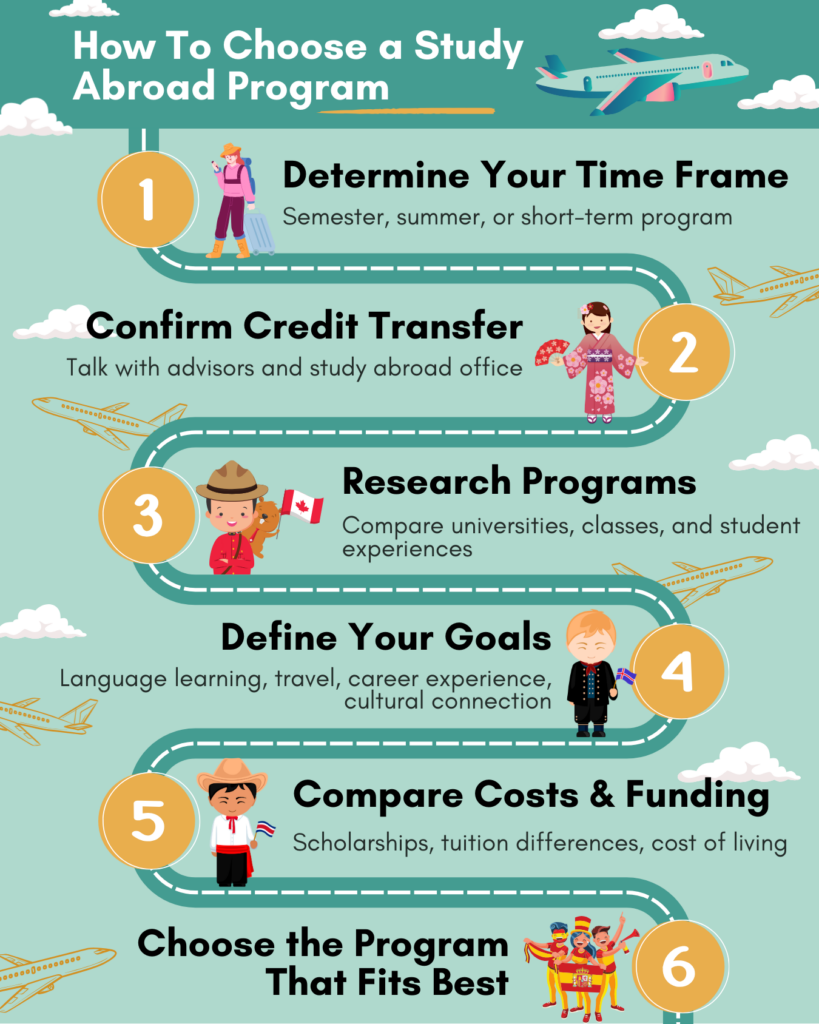
Start With the Calendar, Not the Country
Most students start by thinking about where they want to go. That’s understandable. The romantic image of wandering cobblestone streets in some European city is what draws people to study abroad in the first place. But starting with location before you’ve sorted out your time constraints is working backwards, and it leads to frustration when you discover your dream program runs in the semester you can’t leave.
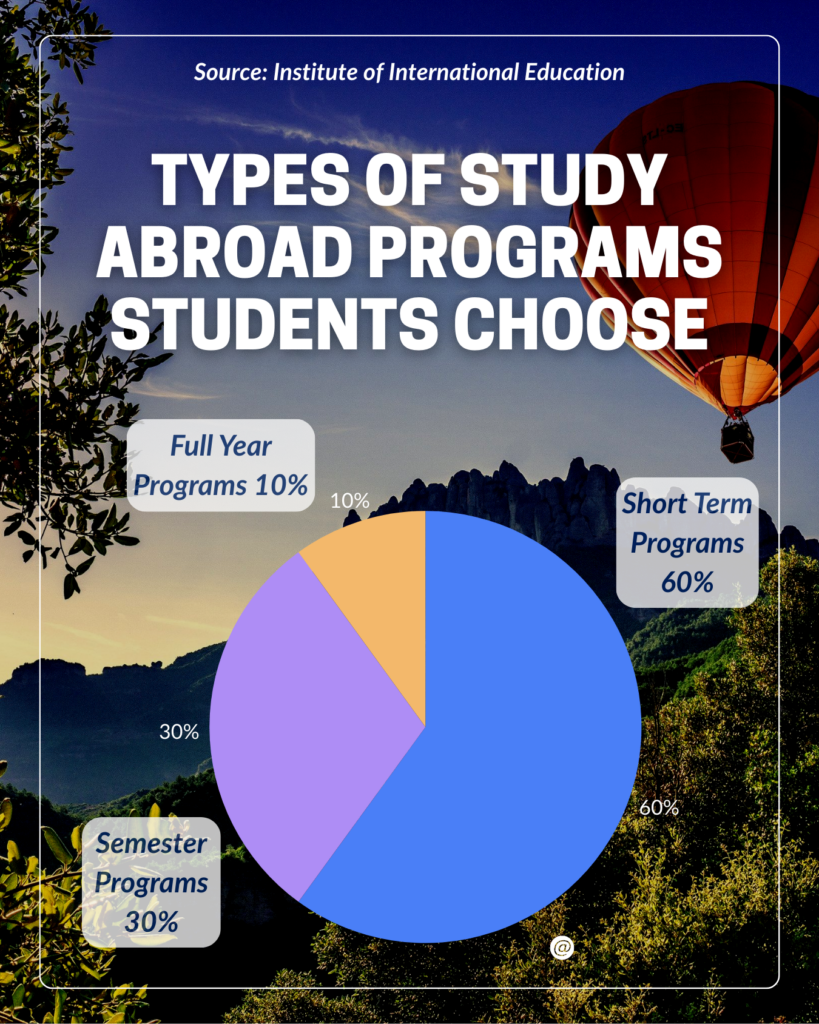
The first question to answer is a practical one, which is how long can you actually be gone? A full academic semester is typically 15 to 18 weeks. Summer programs run 4 to 8 weeks. Short-term faculty-led trips over spring break or winter break have grown enormously in popularity over the last decade because they work for students who can’t rearrange their entire academic timeline. According to the Institute of International Education’s Open Doors Report, short-term programs of eight weeks or less now account for more than 60 percent of all U.S. students studying abroad, which is a significant shift from 20 years ago when semester programs dominated.
Once you know your window, you can start mapping programs to it honestly. Some universities only run their partner programs in a specific semester. Faculty-led programs are often tied to one particular term and don’t repeat every year. If you miss the application window for one program, you may be waiting 12 months for the next cohort. Building a timeline early and working backwards from your target departure gives you enough runway to apply to multiple programs without scrambling at the last minute.
Credit Transfer Is Not a Formality. It’s a Prerequisite.
There is nothing more deflating than coming home from a semester abroad only to find out that the classes you took don’t count toward your degree. It happens more than you’d expect, and the students it happens to almost always say they assumed it would work out rather than confirming it in advance.
Before you fall in love with any program, sit down with your academic advisor and your study abroad office and get explicit written confirmation of which courses will transfer and how they’ll apply to your degree. This is especially important if you’re in a major with strict sequencing. Engineering, nursing, education, and pre-med programs often have requirements that significantly limit which courses can be substituted with outside credits.
The credit transfer landscape has improved a great deal in recent years. Many universities have formal bilateral exchange agreements with international partner institutions, which means a streamlined evaluation process and clear precedent for how courses are classified. Programs run through established third-party providers like IES Abroad, CIEE, and API have also built pre-approved course equivalencies at partner universities, which reduces ambiguity considerably. A useful but often overlooked resource is your university’s registrar’s office, which typically maintains a database of previously evaluated transfer credits. If a student from your school has already had a particular course approved at your target institution, that approval often sets a precedent you can reference in your own petition.
The Overlooked Power of Talking to Former Students
Program websites are designed to make every experience look extraordinary. The photos are curated, the testimonials are hand-selected, and the course descriptions are written by marketing teams. None of that is necessarily dishonest, but it does mean you’re getting a highlight reel rather than a full picture of what the experience is actually like.
The most valuable research you can do is talk to students who actually completed the program. Not just students who loved it, but students with a range of experiences. Ask what surprised them. Ask what they would do differently. Ask whether the academic component felt rigorous or felt like an afterthought. Ask about the housing situation, the social dynamics, and the quality of the university’s support services for international students.
One thing that consistently comes up in those conversations is the importance of integration. There is a significant difference between a program where international students are housed separately and take classes only with other international students, and a program where you’re genuinely embedded in the local university community. The first type can still be an enjoyable experience, but it’s closer to a structured travel program than true immersion. The second type, where you’re sharing classes and social spaces with local students, produces a fundamentally different and usually deeper experience.
Vienna is a good example of this. It’s a city students often overlook in favor of more obviously glamorous destinations like Barcelona, Lisbon, and Amsterdam. But students who go through programs with strong integration policies often rank Vienna above all of those cities. The reason isn’t superior nightlife or more famous landmarks. It’s that the university experience is richer when you actually feel like a student there rather than a visitor who happens to have a student ID. You can find former students through your university’s alumni network, LinkedIn, program-specific Facebook groups, or the “r/studyabroad” subreddit, which is full of candid program reviews and country-specific advice from people who have recently been through the process.
Look for Courses You Can’t Get at Home
This is one of the most compelling arguments for any specific program, and it’s consistently underused as a selection criterion. Every university has gaps, and courses that aren’t offered due to faculty specialization, budget constraints, or simple institutional focus are prime examples. Study abroad is a direct opportunity to fill those gaps in a way that’s both academically meaningful and genuinely enriching.
If your home university doesn’t have a strong sports marketing program and that’s the field you’re going into, finding a European institution with a dedicated sports business curriculum is a real academic advantage. Business programs in particular have significant global variation. The European approach to corporate social responsibility, sustainability, and international trade law differs substantially from the U.S. curriculum, and exposure to those frameworks is professionally useful in ways that can show up in job interviews and early career work.
Language programs deserve special mention here. If you want to become genuinely fluent rather than classroom-proficient, full immersion in a country where that language is the primary medium of daily life is still the fastest and most effective path. The key is choosing a program that actually delivers immersion, which means living with local roommates or a host family rather than in an international student bubble, and taking at least some courses in the target language rather than defaulting entirely to English-language instruction.
It’s also worth looking for programs that offer coursework tied directly to the cultural or geographic context of the location. A marine biology student in the Galápagos, a film student in Rome near the legacy of Cinecittà studios, a public health student in Ghana engaging with community health infrastructure firsthand: these aren’t just interesting experiences. They’re substantive academic opportunities that would be impossible to replicate on a U.S. campus.
Know What You Actually Want Out of the Experience
Before narrowing down programs, it’s worth being honest with yourself about what you’re actually hoping to get out of study abroad, because different goals point toward very different places.
If language acquisition is the priority, you need deep immersion in a country where that language is spoken every day. If travel is the priority, you want a home base with strong transportation infrastructure. Barcelona gives you access to budget airlines like Vueling and EasyJet with routes across Europe, North Africa, and the Middle East. Vienna puts you within a few hours by train of Munich, Salzburg, Prague, Budapest, and Bratislava, which is a remarkable range of cultures and landscapes without ever needing to board a flight. If academic depth is the priority, you want a rigorous curriculum and not a program that treats coursework as secondary to the travel experience.
Some students want to connect with their heritage and spend a semester in the country their grandparents came from, understanding the culture from the inside rather than from stories and old photographs. That’s a powerful reason to choose a specific program, and it tends to produce experiences that are harder to quantify but often the most personally meaningful of all. Research on college student identity development has found that heritage-motivated study abroad produces stronger outcomes on measures of cultural self-understanding than programs chosen primarily for location appeal or perceived prestige.
There’s also the practical question of structure versus independence. Faculty-led programs, where a professor from your home university travels with the group and leads the courses, offer strong support and tend to be less logistically overwhelming for first-time international travelers. Exchange programs and direct enrollment at a foreign university offer more genuine immersion but require more self-sufficiency. Neither is better in the abstract. It depends entirely on what kind of learner and traveler you are.
Think Carefully About Cost and Funding
Study abroad doesn’t have to be as expensive as most students assume, but it does require careful planning and knowing where to look. Tuition costs vary enormously depending on whether you’re enrolled in an exchange program (where you typically pay your home institution’s tuition rate), a third-party provider program (cost varies widely and sometimes includes housing, which changes the math), or directly at a foreign university, which can be dramatically cheaper in some countries. Germany and Norway have historically charged very low or no tuition even for international students at public universities, though direct enrollment requires more independent navigation of admissions and visa processes.
Financial aid is more portable than many students realize. Federal student loans can typically be applied to approved study abroad programs, and some Pell Grant funding can be used for short-term programs. The Gilman International Scholarship, funded by the U.S. Department of State, specifically supports Pell Grant recipients who want to study abroad and is actively underutilized. Eligible students simply don’t apply in the numbers they should, despite average awards in the range of $3,000 to $5,000. Many universities also have their own study abroad scholarship funds that go unclaimed every year because students assume they won’t qualify without ever actually checking.
Cost of living at your destination matters just as much as program fees and is often underestimated. Cities like London, Zurich, and Oslo can strain a budget regardless of how affordable the program tuition looks on paper. Cities like Kraków, Lisbon, Budapest, and Medellín offer dramatically lower day-to-day expenses, which means your discretionary budget for travel, food, and culture goes much further. If budget is a real constraint, factoring the cost of living into your location decision can make the difference between an experience that’s financially stressful and one that’s genuinely enjoyable.
Trust the Feeling, But Do the Work First
There’s a version of this decision that comes down to gut instinct. You see a program, something clicks, and you just know. That instinct is worth respecting. But it works best when it comes after you’ve done the practical work, like confirmed credit transfer, talked to former students, verified that the academic offerings match your goals, and run the numbers on cost.
When you’ve done that work and a program still calls to you, that’s a meaningful signal. Study abroad rewards students who show up curious, open, and willing to be genuinely changed by the experience. The program itself is just a container. What you pour into it determines what you get out.
No matter where you end up going, if you engage fully, you will come back different. You’ll have a more nuanced understanding of how other cultures work, a clearer sense of your own identity by contrast, friendships that span continents, and experiences that simply can’t be replicated at home. Research from the Forum on Education Abroad consistently finds that study abroad alumni report higher rates of intercultural competence, adaptability, and global career readiness than peers who stayed home, and those differences persist years after graduation, not just immediately upon return.
So do the homework, ask the right questions, run the numbers, and then trust yourself to make a good call. The program matters. The decision to go, and to show up for it with genuine curiosity and openness, matters more.
Read More: Why People Are Getting Tired of Influencers
Read More: Why Your Social Media Isn’t Growing & What to Do About It