Running a YouTube Channel as a University Student: 5 Tips
Running a YouTube Channel as a University Student: 5 Tips
Author: Lea Chojdecki
A marketing student at the University of Illinois shares her thoughts on the process of creating content as a university student
It’s not every day that your college professor gives you tips and tricks on how to start a YouTube channel, and you may be inclined to ignore the advice. After all, why would a stuffy old professor know the first thing about the internet? But Professor Wolters is not your typical college level instructor, no no. This man has a channel with one million subscribers, which is something only fewer than 0.1% of all channels have. This man knows the algorithm inside and out, he knows how to grab someone’s attention, and he knows what brings people back to his content repeatedly. But I know that not everybody has the attention span to watch an eight-minute video and would rather read a summary of the video. Just think of this blog post as a spark note for an assignment and you will have no problem finishing it.
Now this video I speak of is a video from Professor Wolters’ secondary channel, where he shares advice for his students on various things, from school to content creation. This video specifically gives advice on how to guarantee the success of your YouTube channel as a hardworking student. There are five big points in his video that I wanted to expand on further and to just give my thoughts on, starting with:
1. Create content based on your interests.
This, I absolutely agree with and might be the most crucial point to follow if you want to succeed at anything in life, not just YouTube. If you do something you don’t enjoy, you’re going to be miserable, I can guarantee it. It’s like that elective you were forced to take in high school just to meet all the graduation requirements when really you just wanted to take the class with 20 seats that only happens once a year. You’re gonna constantly be thinking about what you could be doing. Making content about something you’re passionate about comes with a whole list of benefits. Think about one of your passions in life and think about how much you know about that subject. Chances are, it’s more than the average person knows. Being knowledgeable on the topic your videos are about gives you credibility. If you know a lot about video games, consider making a gaming channel or video game deep-dive content. If you love nature, make informational content on invasive species, extinct animals, or find places to go where you can demonstrate your knowledge by virtually bringing your viewers along for the trip. Your expertise can be felt by viewers, and your enthusiasm to speak about those topics or demonstrate your ability will make an impact on the audience. It’s authentic content, which will be talked about in more detail in a later point.
2. Utilize batch content creation.
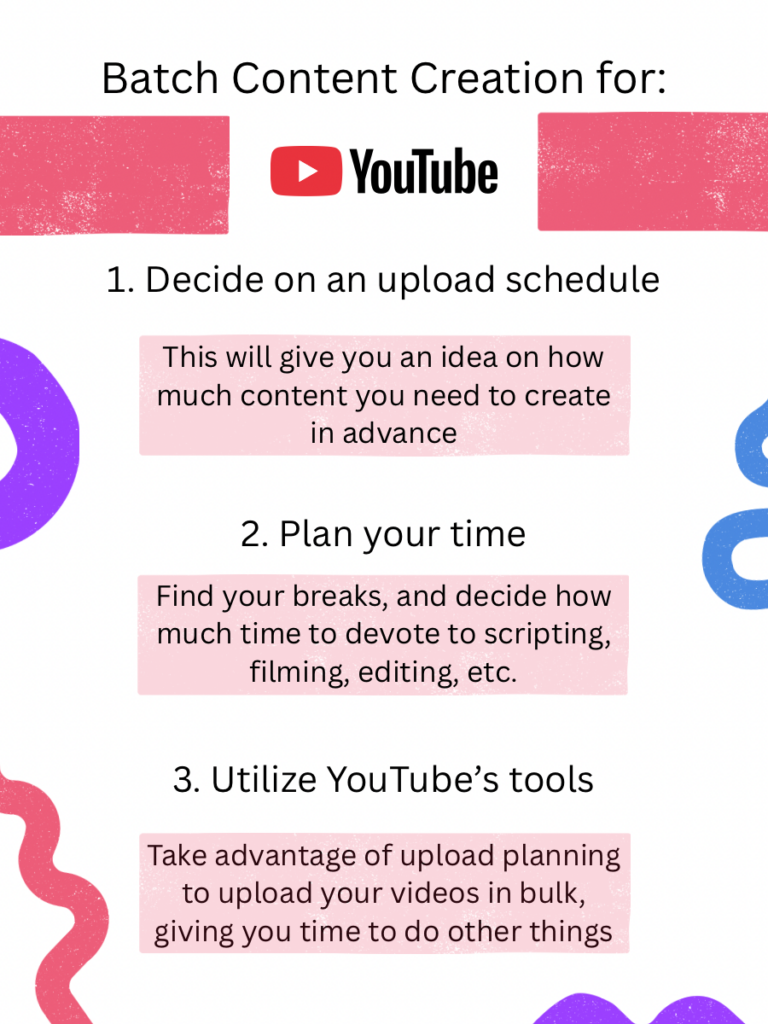
University students are all busy, that’s the reality of it. If you want to make your YouTube succeed, you can’t treat it like your semester project that you put off until the last two days before it’s due. The internet moves, and it moves fast. If you can’t dedicate yourself to making new content regularly, the algorithm is going to stop pushing your videos, and your numbers will fall. You have to be proactive in the video creation process, and this is where this point comes in. Take advantage of your breaks, syllabus week after the start of a semester, weekends, post-midterm lulls, to plan and record content in advance. This involves planning your video upload schedule, so you know how many videos you need to record to meet all those deadlines. Be proactive, because you’re going to be in a lot of trouble if you can’t balance your classwork with your channel. Take advantage of the features YouTube offers that allow you to automatically upload videos at a specified time and date. Doing this sounds like a lot of work, but anything worth doing in life isn’t easy. Give yourself two days to just focus on your videos; first day to record the videos, second day to edit them. It’s just like planning out a project for class, split the steps up, and don’t rush through the process.
3. Adapt your content to trends.
This point is a tricky one, because it’s not telling you to follow trends. Like professor Wolters says in his video, following trends just to get views is a great way to take all of the personality out of your content and ensure that people are just there for the trend, and not for you. You have to be strategic about what trends you do. They should not be the focus of your video, they should just be a unique way to put a spin on a video concept that would have originally not included the trend. Using popular music can be great for attention, but think about the audience you’re trying to target, and how you can incorporate it into your videos that make sense. If you focus on makeup, a great way to do this would be to recreate the look an artist was wearing in their latest music video while the song plays in the background. If you’re a musician, make a reaction video, or dissect the chord progression and the lyrics. You should not follow the trend just for trendiness’s sake. Never lose sight of what your audience comes to your channel for. This is where Professor Wolters tells us how exactly we should know what our audience comes to your channel for. Almost every social media platform out there has some form of analytics tracking that creators can use to track a multitude of things. Use those insights to your advantage. Find which of your videos are gaining the most traction and study them. Find the parts people rewatched the most and deduce why they rewatched that part. Is it because you put in a funny edit? Did something interesting happen in the background? Did you not speak clearly enough? Which trends make you the most views and are there similar things you can do going forward to improve your content? Use trends to your advantage, use your resources, and remember that if people don’t come to your channel for you specifically, you are doing something wrong.
4. Watch and learn from your favorite YouTubers.
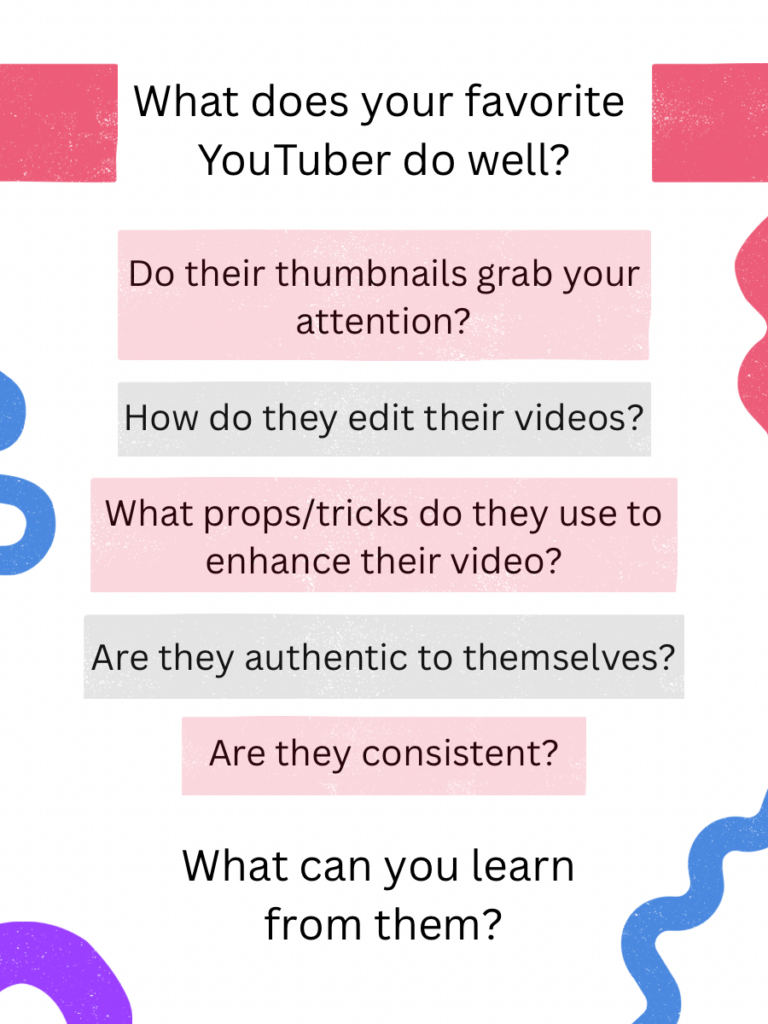
There’s no need for you to be completely original. You can use inspiration to give yourself a foundation before you develop your own style. Don’t flounder around trying different things until something sticks. Think about your favorite creators and why they are your favorites. What about them makes them so attractive for you? What have other people said about them that you can learn from? And do some research on them yourself. Watch their videos, take notes. Find your favorite video they’ve put out and try to pinpoint exactly what it is that makes it so good. Study their commentary, their editing, anything that you find interesting or uninteresting. Take what you like and do it in your own videos, while leaving out the things you didn’t like. This isn’t only limited to videos either, you can study their thumbnails and their titles too. Do some thumbnails stand out more than others? Also look if you can find a distinctive style across thumbnails, something that makes them unique to that creator. One prominent example that comes to mind is the Game Theorists and their thumbnails. Their style is so consistent that they’ve become something of a joke in the community, but it’s immediately recognizable. That big bold font in that lime green color with a video game character front and center makes for an immediately eye-catching image. Think about why these styles may work so well and find something that you can make your own.
5. Put effort into what you do!
During the first point, I said that one was the most important aspect to consider in order to ensure the success of your channel, and I still stand by what I said. However, this is a close second in terms of importance. Low effort content can be funny and succeed on other platforms, but not on YouTube. The days of putting together a slideshow on Windows Movie Maker and posting it to your mom’s account are long gone. Sure, you can still use Windows Movie Maker, but you’d first need a device that can run a 20-year-old program, which already requires more effort than just pulling up iMovie. Old YouTube was wild and untamed, and just about anything could go viral if it hit just the right amount of traction. But after being acquired by Google, and the implementation of ads, a massive shift happened in the landscape. YouTube began to push more refined and professional content, because that’s what advertisers liked being associated with. Some people still don’t seem to understand that, looking back at the YouTube of their childhoods and wanting to be like those early content creators. It’s not all doom and gloom, however. I’m not saying you need to go all out and buy a state-of-the-art camera and have a whole recording studio set up. The effort you need to make is not strictly monetary. This point sort of ties the previous four together, being the overarching idea. If you want your channel to thrive, you need to treat it like a job, and not a side hustle or hobby. You’re going to have to spend some time researching video ideas, editing programs, trends, thumbnail styles, and all sorts of things to deliver the best viewing experience possible. Think of a channel like a child you have to take care of. You must feed it videos, but it’s picky about what it likes to eat. If you give it a half-baked video you took half an hour to record and edit, it’s not going to grow up healthy. It’s only going to grow bigger and stronger if you give it videos created with passion and hard work. Take your time to come up with video ideas in advance so you’re not rushing to get them out. Don’t take the “throw pasta at the wall and see what sticks” strategy. It will waste your time and will harm the growth of your channel by having a collection of videos that are low effort and don’t fit together with the rest of your content. This will take time and commitment, so think carefully about how much time you have and are willing to put into content creation.
If I can offer a point of my own, something I find that makes me more likely to watch a YouTuber is how they interact with their community. The easiest way to do this through YouTube is by using the comment section. Read the comments you get and give them genuine thought. See if anyone is talking about something they liked, or if they found something unclear or not interesting. At the same time, it’s important to not let yourself get dragged down by hate comments. Separate the genuine criticisms from people who are miserable and have nothing better to do than bully people online. You will eventually encounter a troll in your comments, it’s inevitable, but it’s your job to not let it get to you. But don’t discount the comments that express negative opinions on your content, because those give you an opportunity to grow and do better going forward. Consider replying to your viewers to express gratitude or to ask them how you can improve. It helps to establish a bond between you and your audience, making you less of an ethereal, unreachable figure. It lets viewers know that you care about them and their viewing experience. This of course is much easier to do as a small channel, when you get under 50 comments each video, and can take time to read and reply to most, if not all of them. Anything above 100, reply to a few of your favorites, and you can leave a heart on the rest of them. Even the simple action of receiving a heart from a creator makes a user more likely to watch and engage with more of a creator’s videos. You don’t have to talk to all of your fans, just let them know you appreciate them.
Anyway, I highly recommend checking out the video if you appreciated my ramblings. But if advice for students isn’t your flow, go check out Professor Wolters’ other channel, Wolters World. It’s a travel channel with tons of great advice for first time travelers, veterans, and everyone in between.