The Complete Guide to Influencer Campaigns: How to Get Paid and What to Avoid
Author: Nicole Gieres
Nicole Gieres is a business and marketing student at the University of Illinois with an interest in branding, digital strategy, and influencer marketing.
If you are studying business or marketing, influencer marketing has probably already come up in a class or two. Maybe you have thought about becoming a creator yourself or tried to be one, or maybe you are more interested in working on the brand side after graduation. Either way, most of the content out there on this topic only covers the basics: here are the campaign types, here is what they pay. What it usually skips is everything that actually determines whether a campaign succeeds, including the legal rules that are getting brands sued right now, how to tell when a creator’s followers are fake, and why more than half of all influencer campaigns still miss their goals even as the industry closes in on $40 billion.
This blog is written to go past the surface level. We’ll review the eight campaign types for a quick summary first and get into real examples of what went wrong in 2025, a breakdown of FTC rules most students do not know exist until they are already in a job, and practical advice for getting started whether you want to be a creator or manage campaigns for a brand after graduation.
Why This Industry Is Worth Paying Attention To
Influencer marketing closed 2025 at $32.55 billion globally according to Influencer Marketing Hub, and projections for 2026 put it above $40 billion. It has grown roughly 20 times over since 2016. Brands are not moving that kind of money into a channel that does not produce results.
The reason it works is not complicated. About 69% of consumers trust recommendations from influencers more than they trust direct advertising from brands. Think about your own habits. When you are deciding between two products, you probably look up a video review or check what someone you follow has posted about it before trusting the brand’s own website. That is exactly the instinct influencer marketing is built around, and brands are currently seeing an average of $5.78 back for every dollar they spend on it.
What surprising is more than half of influencer campaigns still miss their performance goals according to The Cirqle’s 2025 analysis. The industry is growing fast, but that does not mean most campaigns are actually working. The failures almost always come down to picking the wrong campaign type for the goal, or partnering with the wrong creators. That is what the rest of this blog is here to help understand.
The 8 Main Types of Influencer Campaigns
Each of these formats works differently, pays differently, and is designed for a different goal. A lot of brands treat them as interchangeable and that is usually where things start to go wrong.
1. Sponsored Posts
A brand pays a flat fee for a creator to publish content featuring their product. The creator adds a #ad or #sponsored disclosure and gets paid regardless of whether the post drives any sales. The brand is paying for visibility with that creator’s audience, not a guaranteed result. Gymshark built most of their early brand this way by partnering with fitness creators like Nikki Blackketter who genuinely lived the lifestyle the brand was selling. The posts worked because they fit naturally into those creators’ content.
2. Affiliate and Promo Code Campaigns
Affiliate campaigns flip the payment structure. The creator gets a unique link or discount code and only earns money when someone actually buys through it. This is the mechanism behind every creator code you have ever seen. Influencer Marketing Hub’s 2025 data shows 53% of brands now prefer this model because they only pay for results. For creators, the upside is that a good review video keeps earning commission for months or years after it is published, which is why a lot of creators build their income strategy around affiliate content.
3. Product Gifting and Seeding
Seeding is when a brand sends free products to creators without requiring them to post anything. The idea is that an unprompted recommendation carries more weight with an audience than a paid one, because there is no financial motive behind it. Glossier built their entire early following this way, sending products to skincare enthusiasts who genuinely loved what they received. One thing worth knowing now though is even this casual arrangement still triggers FTC disclosure requirements if the creator ends up posting about it, which will be covered in detail in a later section.
4. Unboxing and Review Campaigns
Unboxing content has been one of YouTube’s most durable formats since the platform’s early days. Watching someone open a product and share their honest first impression is genuinely useful when you are trying to decide whether to buy something. YouTube influencers generated 28.4 billion engagements in the U.S. alone in 2024, and review content tends to hold up in search results for years, which makes it one of the better long-term investments for both creators and brands.
5. Brand Ambassador Programs
Ambassador programs are longer-term deals where a creator represents a brand consistently over months or years instead of a single post. These usually come with better pay, sometimes exclusivity, and occasionally real input into products. Deeper Sonar, a fishing tech company, manages a network of over 7,000 ambassador creators across 30 countries with a team of five people by using a tiered structure. For creators, an ambassador deal is often the goal because it means steady income instead of constantly pitching new brands.
6. Giveaway Campaigns
Everyone has seen and did these before. Follow both accounts, like the post, tag a friend to enter. Giveaways are one of the fastest ways to grow a following because the entry mechanics push the post to new audiences. Sprout Social found that 65% of marketers use this format primarily for fast audience growth. The trade-off is that people who follow an account to win a prize are not always going to buy anything or stick around long term. Giveaways work best as a visibility tool paired with other formats that can actually convert that new audience.
7. Event Activations
Event activations take influencer marketing offline. Brands invite creators to launches, pop-ups, or exclusive experiences and the creators document everything in real time. The energy of an actual event comes through in a way a scripted sponsored post never does. One well-run activation can produce weeks of authentic content across multiple creators. The trade-off is a larger budget covering travel and production on top of creator fees.
8. Product Collaborations
Product collabs are the highest-stakes version of an influencer partnership. The creator is not just promoting a product, they are helping design one. Rhode’s collaboration with TikTok creator Alexandra Saint Mieux on limited-edition phone cases that matched their lip tints is a recent example. It felt like a real creative project rather than a brand add-on, it sold out fast, and it got covered by media outlets well beyond Rhode’s own channels. A well-executed collab generates attention that money alone cannot buy.
The Legal Side That Most Students Don’t Know About
This is probably the most important section in this blog for anyone heading into a marketing role, and it is almost never covered in basic influencer content. The legal rules around influencer campaigns have gotten much stricter over the past two years, and the consequences for ignoring them are no longer just a slap on the wrist.
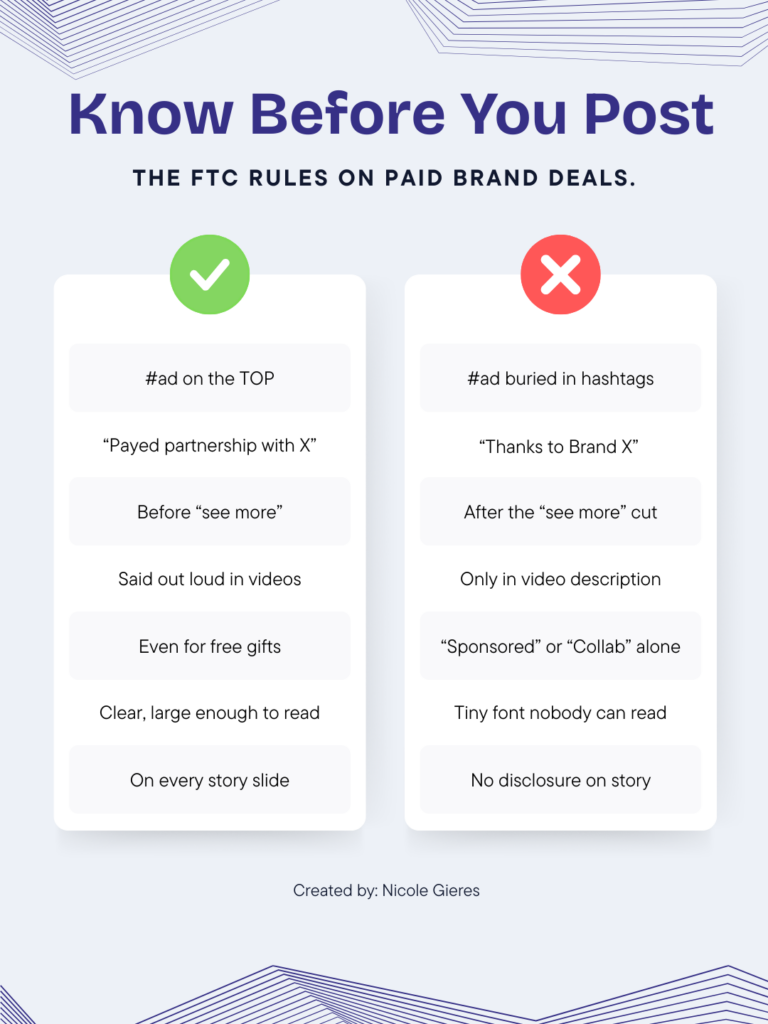
The FTC requires that any material connection between a creator and a brand be disclosed clearly in the content itself. A material connection includes payment, free products, affiliate commissions, discounts, or personal relationships with the brand. The disclosure has to appear where people will actually see it, not hidden at the end of a long caption after twenty hashtags. According to the FTC’s enforcement guidance, fines can reach $51,744 per violation and both the creator and the brand can be held responsible.
Something that catches a lot of people off guard is that even sending free products with no posting requirement still triggers disclosure rules if the creator ends up posting about it. Honigman Law’s compliance guide breaks this down in plain terms, and it is worth reading before you take on any brand work. The casual feel of getting a free product in the mail does not change what the law requires.
In 2025, the stakes got higher when class action lawsuits started targeting brands directly. A $50 million lawsuit was filed against fashion brand Revolve and several of their influencers for presenting paid partnerships as genuine organic recommendations. A similar lawsuit hit Shein after influencers buried their disclosure in a wall of hashtags where almost nobody would see it. Morgan Lewis’s 2025 breakdown of these cases explains why lawyers are likely to keep filing similar suits going forward.
The practical rule for anyone starting out is to disclose everything, put it at the top of the post in plain language, and treat it as a non-negotiable part of your process. Traverse Legal has a clear and updated FTC compliance guide that I found helpful when researching this topic. Found below is also an infographic summarizing the do’s and dont’s.
Three Campaign Failures from 2025 Worth Studying
Some of the most useful things you can learn in marketing come from studying what went wrong. 2025 had several high-profile influencer campaign failures that are worth knowing about before you find yourself in a role where you could make the same mistakes.
The beauty brand filter scandal. A major beauty brand ran a campaign promoting a foundation as delivering “filter-like skin in real life.” Multiple influencers used AI editing tools and beauty filters in their sponsored posts, making it impossible for viewers to tell whether the product actually worked. The FTC fined both the brand and the creators for deceptive advertising. The bigger problem was the consumer backlash. Once people figured out what happened, the negative coverage far outpaced whatever the original campaign had generated.
The trend timing problem. A fashion retailer built an entire campaign around Y2K nostalgia targeting Gen Z and launched it after the trend had already peaked. The brand had used outdated market research instead of real-time social listening. Trends in this space can peak and fade within weeks, not quarters. Campaign timelines that are normal in traditional advertising are often too slow for influencer marketing, and this one is a clear example of why.
The crisis response that made things worse. When a high-profile influencer partnership drew public backlash, the brand put out a statement that read like it was written by a legal team rather than actual people. It did not address what the audience was upset about and offered no real response. The backlash escalated because of the statement, not despite it. Audiences today can tell the difference between a genuine response and a PR deflection, and they react accordingly.
How to Spot a Fake Audience
One of the most expensive mistakes you can make in influencer marketing is paying for a campaign with a creator whose audience is not real. Research from HypeAuditor found that about 45% of influencers worldwide have some degree of artificially inflated metrics from purchased followers, bots, or engagement pods. That means nearly half of the profiles you might look at are showing numbers that do not reflect actual people.
If you are ever in a role where you are evaluating influencer partners, here are the things to check:
- Engagement rate: For micro-influencers (10K to 100K followers), a healthy rate is roughly 2% to 5%. For larger accounts, above 1.5% is solid. Anything well below these numbers is worth questioning.
- Comment quality: A lot of generic comments like ‘great post!’ or single emoji replies are often signs of bots or engagement pods. Real followers leave specific, varied responses that relate to the actual content.
- Follower growth pattern: A sudden large spike in followers followed by a plateau is a classic sign of a purchased follower package. Organic growth is gradual and consistent over time.
- Audience location: Always ask for an audience demographics breakdown before agreeing to a deal. If a U.S.-based creator has the majority of their audience in countries that have no connection to the brand’s market, that is a red flag.
Matching the Right Campaign to the Right Goal
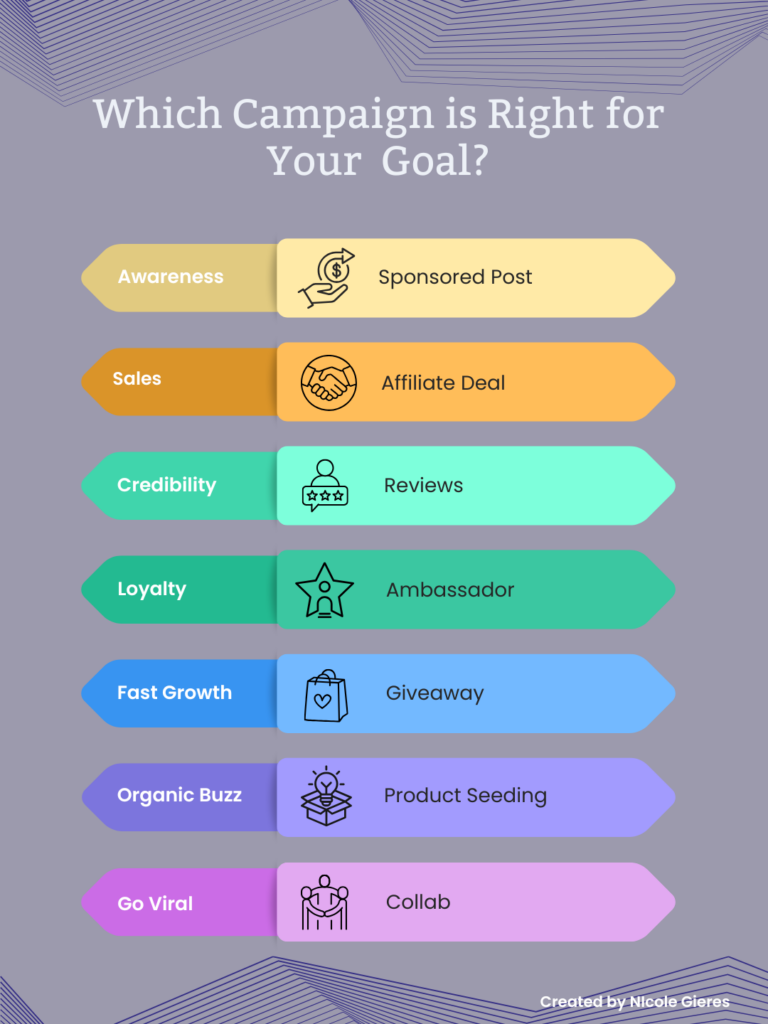
The most important thing to take away from this blog is that each campaign type is built for a specific purpose. Using the wrong format for your goal is one of the most reliable ways to waste a marketing budget. Here is a quick reference:
- Building awareness: Sponsored posts and event activations with larger creators for maximum reach.
- Driving sales: Affiliate campaigns. You only pay when someone buys, and creators are motivated to convert.
- Launching a new product: Unboxing and review campaigns. Give hesitant buyers the honest, in-depth look they need before committing.
- Building long-term loyalty: Ambassador programs. Repeated, consistent association between a trusted creator and a brand is hard to replicate any other way.
- Growing an audience fast: Giveaways. Good for follower growth, weaker for conversion. Best paired with other formats.
- Generating organic credibility: Product seeding. Works best when the product is genuinely strong.
- Creating a cultural moment: Product collaborations. A well-executed collab generates press and coverage well beyond the brand’s own audience.
For more on applying these frameworks with real data, Sprout Social’s influencer marketing guide and Influencer Marketing Hub’s annual benchmark report are both free and updated regularly. I found both useful when putting this post together.
You Don’t Need Millions of Followers to Get Paid
This is the biggest misconception people have about becoming a creator. Bigger is not automatically better when it comes to brand partnerships. In 2025, 73% of brands said they preferred working with micro and nano-tier creators over celebrities. The reason is engagement. A smaller creator with a focused, attentive audience is often more valuable to a brand than a celebrity whose millions of followers barely interact with their content.
- Nano (1K to 10K): TikTok nano-influencers averaged around 10.3% engagement in 2025 compared to well under 1% for mega accounts. If you are building a creator platform in a specific niche, this means you can start landing real partnerships earlier than most people think.
- Micro (10K to 100K): The best ROI tier for most brands. Daniel Wellington built a globally recognized watch brand almost entirely through partnerships with thousands of micro-influencers at once. This is the milestone most aspiring creators should be working toward first.
- Macro (100K to 1M): Professional full-time creators with broader audiences and high production quality. Higher rates, still strong engagement relative to the tier above.
- Mega and celebrity (1M+): Maximum reach but engagement drops sharply as follower counts climb. Best for big awareness campaigns, like Redken signing Sabrina Carpenter to reach a younger demographic quickly.
Where Campaigns Are Happening in 2026
Platform choice matters more than most people realize when it comes to campaign format. Instagram leads with about 57% of brands prioritizing it. TikTok sits at 52% but saw a real drop in brand investment during early 2025 when regulatory uncertainty around the app was at its peak. A lot of brands responded by spreading their budgets across multiple platforms rather than betting everything on one. YouTube holds steady at around 37%.
Each platform suits different formats. YouTube’s longer videos give creators time to genuinely demonstrate a product, which is why reviews perform so well there. TikTok rewards fast, high-energy content, which works well for product reveals and quick affiliate promos. Instagram is where visually aesthetic campaigns shine, especially in fashion and beauty.
The format worth watching heading into 2026 is live shopping. TikTok Shop hit over $20 billion in gross merchandise value in 2024 and it is starting to gain serious traction in Western markets. Think of it as QVC for social media. Creators who get comfortable with live selling now are going to have a real advantage as it becomes a standard part of more brand campaigns.
How to Actually Get Started as a Creator
If you are a college student or someone thinking about building a creator platform, the most important thing to know is that you do not need a huge following to start earning. Given that 73% of brands in 2025 preferred smaller creators, the path to a first paid partnership is genuinely shorter than most people assume. What matters more than follower count is having a clear niche and an audience that actually engages with your content.
- Pick a specific niche and commit to it. A focused content identity makes it easy for brands to understand who your audience is. Vague lifestyle accounts are much harder to pitch.
- Prioritize engagement over follower count. A 5% engagement rate on 15,000 followers is more attractive to most brands than 0.3% on 200,000. Saves, comments, and shares are what brands are actually looking at.
- Start earning through affiliate programs now. Amazon Associates and LTK are both open to creators at virtually any audience size. The Sociable Society has a helpful breakdown of beginner affiliate programs worth reading before you sign up for anything.
- Reach out to brands directly. A lot of smaller brands have no formal influencer program but will respond to a well-prepared pitch email that includes your audience demographics and engagement rate.
- Learn the legal requirements before you need them. Disclosure is not optional, even for unpaid gifting. Building it into your process from the start is a lot easier than fixing a complaint after the fact.
For more detail on building a creator pitch and what brands actually look for, Ambassador’s micro-influencer guide and Afluencer’s breakdown of creator portfolios are both worth reading before you reach out to your first brand.
Final Thoughts
Influencer marketing is a $32.55 billion industry heading toward $40 billion, and if you are going into any area of business or marketing, understanding how it works is quickly becoming a baseline expectation. The campaign types are the starting point, but the real knowledge comes from understanding which format fits which goal, how to evaluate whether a creator’s audience is genuine, what the legal requirements actually are, and what the failures of 2025 can teach you before you make the same mistakes yourself.
The brands and creators doing best in this space are not just the ones who showed up with a big budget or a big following. They are the ones who understood the structure well enough to make smart, deliberate decisions at every step of the process. That is what this blog was written to help you do.
For staying current on all of this, Influencer Marketing Hub releases a free annual benchmark report that is one of the best resources in the industry, and Sprout Social’s influencer statistics page gets updated regularly with current platform data. Both are worth bookmarking if this is an area you plan to work in!