Beyond the “Like”: Why Marketers Prioritize Actionable Metrics Over Vanity
By: Jovany Valenzuela – Marketing Enthusiast who focuses on Social Media Success for small and medium size brands
Beyond the “Like”: Why Marketers Prioritize Actionable Metrics Over Vanity
We have all been there. You post a photo or a video, and within minutes, the notifications start rolling in. The little red bubbles on your screen represent likes, shares, and new followers. It feels great, right? In the world of social media marketing this is what is called a “dopamine hit.” Whether you are an individual creator or a social media manager for a massive corporation like Nike or Walmart, it is incredibly easy to get addicted to these rising numbers.
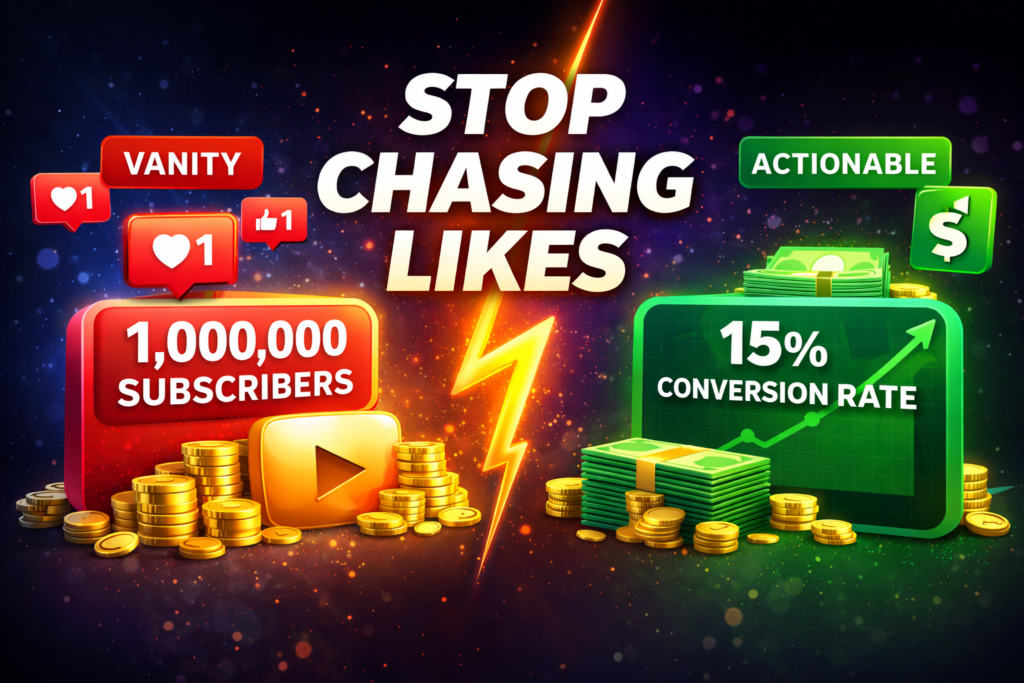
However, as Professor Wolters points out in his recent breakdown, there is a dangerous trap hidden within these “feel-good, look-good” stats. A million subscribers might look amazing on a YouTube channel’s homepage, and a gold play button looks great on a wall, but do those numbers actually pay the rent? For young professionals and students entering the marketing field, the most important lesson we can learn is knowing the difference between Vanity Metrics and Actionable Metrics.
What are Vanity Metrics?
Let’s start with the basics. What exactly is a vanity metric? These are data points that look impressive to outsiders but don’t necessarily correlate with actual business impact. They are surface-level stats. If you were looking at a car, the vanity metric would be the shiny paint job. It looks expensive, but it doesn’t tell you if the engine runs well. Some common vanity metrics include:
- Total Subscriber or Follower Count: It’s easy to think that a larger audience equals a better business. But if those followers aren’t seeing your content, or worse, if they are ghost accounts that never engage, that number doesn’t mean much.
- Raw View Counts: High views mean reach, but they don’t tell you if the viewer actually cared about the content. A video can get 100,000 views, but how long did those people stay? If 90% of them clicked away after three seconds, did they actually receive your message?
- Likes: A simple double-tap is the lowest form of engagement since they require the least amount of effort from a user. A double tap is often an automated habit rather than a sign of true brand loyalty that can give truthful insights to a brand owner.
The core issue here are the insights. Vanity metrics often lack the “so what?” factor. If your boss asks, “We gained 5,000 followers this month, what does that mean for our sales?” and your only answer is “It means people like us,” you are in trouble. You need data that leads to a business action. Predictable metrics that the company can rely on to help them make the next move and have some guarantee that they will see some sort of improvements.
The Power of Actionable Metrics
If vanity metrics are the shiny paint, actionable metrics are the engine and the fuel that actually make everything move. Actionable metrics are the analytic numbers that allow you to take informed and predictable business actions instead of just guessing what might work. These are the stats that explain why something is working and what you can do to improve in the future. While vanity metrics can make a post look successful on the surface, actionable metrics show whether that success is actually leading to growth, engagement, or real results.
Actionable metrics focus on what people actually do, not just what they see. They help you understand if your strategy is working and make it easier to adjust your content in a smarter way. Because of this, they are much more useful when you are trying to measure real progress instead of just attention.
If you want to gain credibility within the marketing industry as a social media manager, these are the numbers you should be paying attention to and reporting. Anyone can show likes or follower counts, but professionals are expected to explain results in a deeper way. These are the numbers that show you understand how to use data to make better decisions and improve over time.
- Engagement Rate
Unlike a simple like-count, the engagement rate is a percentage. It measures the total number of interactions (comments, shares, saves, and likes) relative to your total audience size or reach. High engagement shows that your content is resonating, relatable, and building a community.
- Why it’s Actionable: If your engagement rate is dropping even though your follower count is growing, it’s a red flag. It tells you that your current content isn’t resonating with your audience. Action: It’s time to pivot your creative strategy to reconnect with your community.
- Click-Through Rate (CTR)
CTR is the ultimate “gatekeeper” metric. It tells you how many people saw your post or thumbnail and actually felt compelled to click on it.
- Why it’s Actionable: If you have a low CTR on a YouTube video, it doesn’t matter how good the video is, nobody is seeing it. Action: Change the thumbnail or rewrite the headline. High CTR means your hook is working; low CTR means you’re losing people at the front door.
- Conversion Rates
A conversion happens when a viewer turns into a user, a subscriber, or a customer. Whether you are trying to sell a product or just get people to join an email list, tracking how many people convert and complete the desired action is the ultimate measure of success.
- Why it’s Actionable: This is the bridge between marketing and revenue. If you have 1,000,000 views but a 0.01% conversion rate, your content is entertaining but not persuasive. Action: Strengthen your call to action (CTA) or look for friction in your checkout process.
- Customer Lifetime Value (CLV)
CLV is essential. It tells you the average profit a single customer will bring to your business over time. By knowing your CLV, it helps you decide exactly how much you can afford to spend on marketing to acquire that customer.
- Why it’s Actionable: If you know a customer is worth $500 over their lifetime, you know you can afford to spend $50 to acquire them. Action: This dictates your entire advertising budget and helps you identify which types of customers are the high-value ones you should be targeting.
Context is Key: When Vanity Metrics Actually Matter
It is important to highlight that vanity metrics are not bad on their own, they just need to be looked at in the right context. Metrics like views, likes, reach, and followers often get criticized because they do not always show real results, but that does not mean they are useless. The value of these numbers depends on what your actual goal is. If your main objective is brand awareness, then vanity metrics can actually be very important. For example, if a company is trying to introduce a new product or make more people familiar with their name, having a high number of views or a large reach means the message is getting in front of more people. In this situation, those metrics are not just for show, they are helping measure how visible the brand really is.
On the other hand, if the goal changes to something more specific like increasing sales, getting sign-ups, or growing revenue, then those same metrics are not enough on their own. A video can get thousands of views, but if nobody clicks the link or makes a purchase, then the campaign is not really successful. That is when it becomes necessary to focus more on actionable metrics such as click-through rate, conversions, return on investment, or customer lifetime value. These numbers give a clearer picture of whether the marketing effort is actually leading to results. Overall, it is important to highlight that vanity metrics are not bad, they just need to match the purpose of the campaign.
(Insert infographic #2 here)
Putting it into Practice!
Let’s look at a real-world scenario. Imagine you are running a social media campaign for a local campus organization or a small business like a construction company or a local band.
You post a high-energy “Day in the Life” video. It gets 10,000 views and 500 likes. On the surface, you’re celebrating! But when you dig into the Actionable Metrics, you see that the average watch time was only 5 seconds, and only 2 people clicked the link in your bio.
From a vanity perspective, the video was a hit. From an actionable perspective, the video was a failure because it didn’t drive the intended result.
This is why we need both. Professor Wolters mentions that context is key. If your goal is purely Brand Awareness (just getting your name out there), then vanity metrics like reach and views are actually helpful. They tell you that the top of your funnel is wide. But if you are trying to build a sustainable business, you cannot live on awareness alone. You need the bottom of funnel metrics (Conversions and ROI) to stay in business.
Why Modern Brands are Moving Away from “The Big Numbers”?
In the past few years, we’ve seen a massive shift toward “micro-influencers.” These are creators with 10,000 to 50,000 followers instead of millions. Why would a brand like Nike or a local startup hire someone with fewer followers? The answer is actionable engagement. A micro-influencer often has a much higher engagement rate and a more loyal conversion rate than a celebrity. Brands have realized that they would rather reach 10,000 people who are 10% likely to buy than 1,000,000 people who are 0.001% likely to buy. As you build your own brand or manage others, don’t be discouraged if your total followers aren’t growing as fast as you’d like. Focus on the people who are actually clicking, commenting, and converting. That is where the real value lives.
It’s not just about reporting numbers but interpreting them!
When giving the figures to a client, a professor, or even your own team, it is not enough to simply present a table filled with statistics and hope that the figures speak for themselves. Most people do not immediately connect with the raw data provided, especially when they were not the ones collecting the data. That is why it is so important to turn the figures into a story that people can actually understand and connect with. Rather than simply providing the figures and the statistics, it is important to be able to explain the meaning and the reason for the figures. When the data is provided in such a way that it can be related to real actions and real reactions from people, it is much easier for others to understand the value of the work.
For instance, instead of simply writing, “Our click-through rate was 4%,” you might write, “Our click-through rate was 4%. This was because our audience responded really well to the behind-the-scenes content we posted on Tuesday, and this post was able to bring twice as many people to our website compared to the usual product photo content that we post.” This not only provides context to the numbers but also lets the reader of the report know what worked, what didn’t, and what they need to do again in the future.
The reason this is important is that marketing is not just about numbers, algorithms, and social media sites; it is about people and how they react to what they see and experience. The key is that you can learn about the behavior of people, such as what grabs someone’s attention, what makes them click on something, and what makes them want to keep going with what they are interested in. The reason that these types of metrics matter is that you are able to learn what people actually care about and what they find interesting and useful, which is far more important than knowing how many views you received on something, because you can learn how to make a stronger connection with your audience and build a community rather than just accumulating numbers.
Ready to Learn More?
If you want to further learn more about the topics mentioned and strengthen those skills, check out these additional resources:
Summary for Success:
- Stop chasing dopamine: Likes are nice, but they don’t buy groceries.
- Focus on the Click: If they aren’t clicking, they aren’t listening.
- Context is King: Know your goal before you pick your metric.
- Stay Action-Oriented: If a number doesn’t tell you what to do next, ignore it.