Stop Wasting Your LinkedIn: 7 Mistakes You’re Probably Making (And How to Fix Them)
A Guide for College Students and Recent Graduates Who Want to Stand Out Online
By Radha Mehra – Marketing Specialists with a focus on social media and consumer behavior.
Let’s face reality for a second. You have a LinkedIn account. Maybe you created it just because your professor told you to, or perhaps you created one because you heard it could help you land a job someday. Maybe you created one just because everyone had one. The thing is: just having one is not enough. Just like how driving a Ferrari and racing one are different things, just like knowing how to play chess and playing chess well are different things, or knowing how to use LinkedIn and utilizing LinkedIn well are different things. The sad part is that most people, especially college students and recent graduates, are committing the same mistakes over and repeatedly. The good news is that this article is going to help you avoid those mistakes and even correct the ones you have already made. The information contained herein is from a social media marketing expert who has spent years teaching professionals how to use social media effectively. So, are you ready to learn?
First Things First: Your Profile is Your First Impression
But before we get into posting strategies or types of content, we need to focus on your profile, because if your profile is not set up correctly, nothing else you do on LinkedIn is ever going to matter that much.
First off, what is the biggest mistake people make on LinkedIn? It is not filling out their profile completely. This is common sense, but you would not believe how many people do not fill out their profiles completely. No profile picture, no idea what their headline summary is about, and their experience is just thrown together in five minutes.
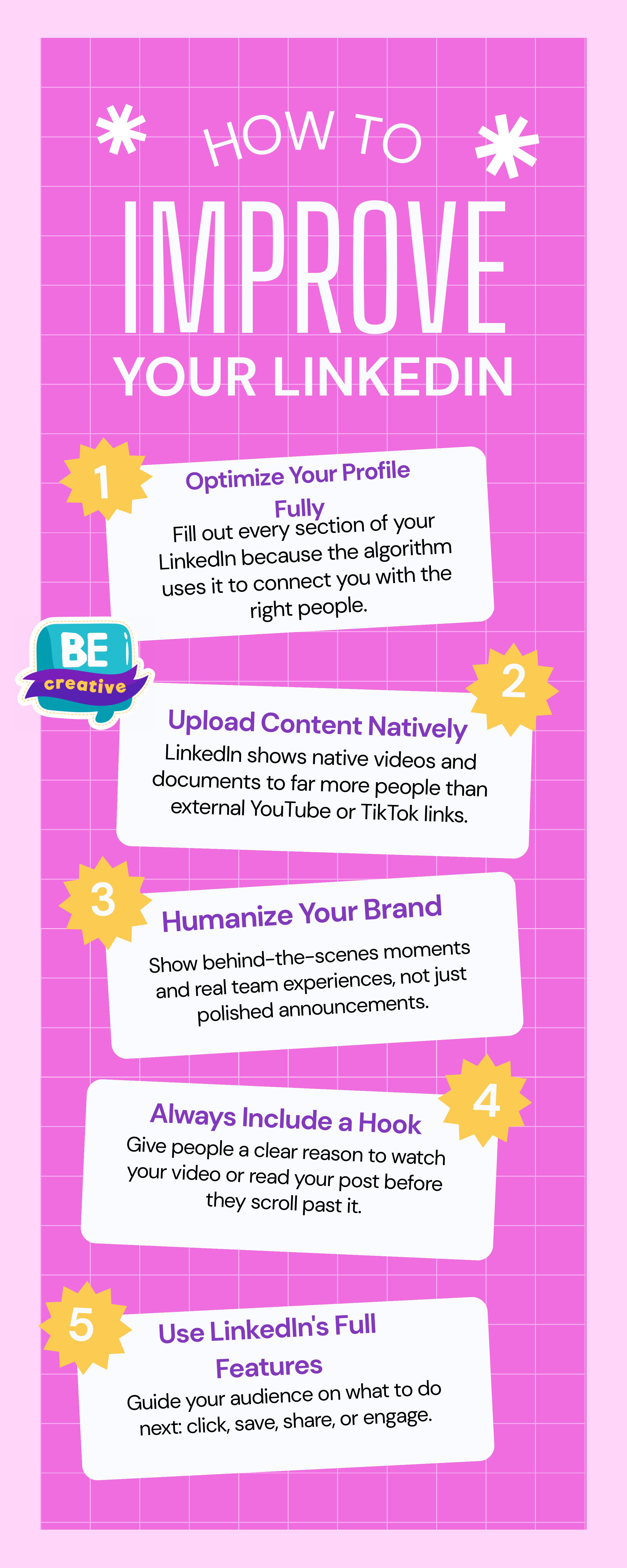
This is what your LinkedIn profile should include:
•Your professional profile picture. Not a party selfie. Not a picture of your dog. A well-lit, in-focus picture of your face that looks friendly and put together. Research has consistently shown that profiles with pictures receive exponentially more views than those without.
•Your banner picture. That default blue background is doing nothing for you. You can use this space to show off a part of yourself, your industry, or even a simple graphic with your name and title.
•A headline that does something. Your headline is not just your title. It is a space of high importance. Instead of writing ‘Marketing Student at State University,’ why not try ‘Aspiring Digital Marketer | Social Media Strategy Enthusiast | Looking to Help Brands Grow Their Online Presence’?
•Your entire work and experience history. Don’t be embarrassed by those part-time jobs, internships, or volunteer work. The more information LinkedIn’s algorithm has, the better it can connect you with others who matter to you.
•Awards, certifications, organizations, groups. They help paint a picture of who you are as a professional. Don’t skip these.
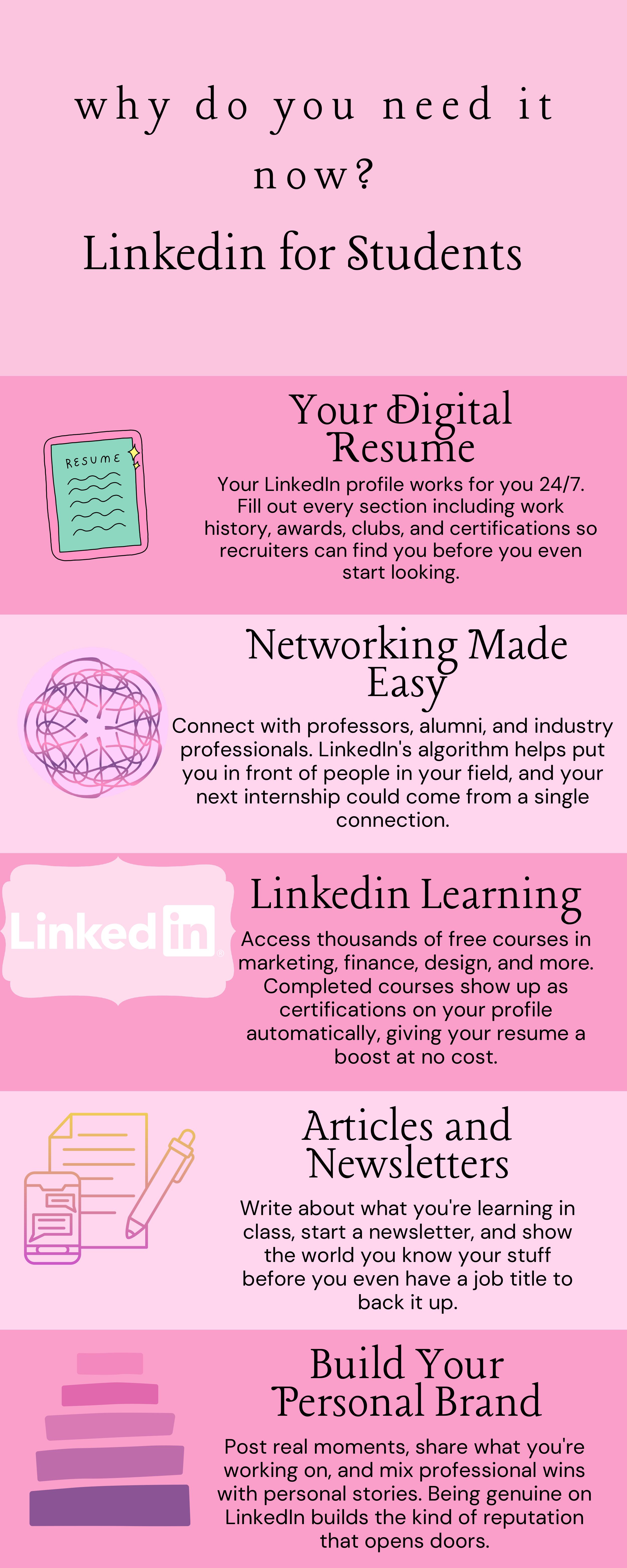
Your LinkedIn profile is like a resume, but it’s one that’s available always, searchable always, and has the potential to be seen by thousands of people who are looking for someone just like you.
Mistake #1: Turning Your Page into an Infomercial
This is one of the biggest mistakes new students of personal branding or business branding make. Social media has never been a sales medium. Never. And it’s not about to start now, not even on LinkedIn.
When your entire social media presence consists of ‘Buy our product!’ or ‘Sign up now!’ or ‘We’re the best in the business!’ people quickly stop paying attention. Hard sell posts do not belong on social media. People do not use social media to be sold to. They use it to learn, to network, and to have a good time.
What works? Value-based posts. Think about what you can offer people that will be of value to them. What can you share that will be of interest to them? If you’re a business, it could be stories of people who have succeeded using your product, stories about what’s trending in your industry, or even tips that people can use in their everyday lives. If you’re a student, share what you learned from a class, a project, or even a failure.
The goal is to show what you bring to the table, not shout about it. When you consistently create content that helps people, your reputation grows naturally. And a strong reputation sells itself better than any ‘Buy Now’ button ever could.
Mistake #2: People Connect with People, Not Logos
This is true for businesses, of course, but it’s also true for individuals. The most magnetic thing you can do on LinkedIn is to allow others to catch a glimpse of the humanity in what you do. Far too many businesses rely solely on announcements, press releases, and slick marketing materials. That’s fine, but it’s not going to drive engagement. The things that drive engagement are those moments of humanity, those moments of authenticity. Think about it. The things that stop your scrolling, that stop you moving down a page, are those moments of authenticity. That’s why a picture of a company’s team-building day is going to drive engagement. That’s why a picture of someone at work is going to drive engagement. That’s why a post about how something didn’t go well, but what was learned, is going to drive engagement. For you, as a student or new graduate, that’s your advantage. Share your humanity. Share your lived experience. Share how you learned, how you studied, how you succeeded. Share how you burned the midnight oil to finish a project. Share how you succeeded in getting a client. That’s going to drive a huge engagement. Not only is it real, but others in that same life stage will be able to relate to it. You don’t have to be one or the other.
Mistake #3: Posting Without a Hook
The harsh reality about online content is that nobody is ever obligated to give your content their attention. Every time they swipe past your post, they are making an instant decision about whether they should stay and engage with your content.
This is why the hook, the first line or first few seconds that grabs their attention is so vital. It doesn’t matter how good your blog post is or how helpful your video is. If the first line of your caption or the first three seconds of your video doesn’t give them a reason to stay and keep engaging with your content, then they won’t.
Too many people are just posting their link with no context. They are posting their document with no explanation. They are posting their video with no explanation. Don’t do this.
Some good hooks are:
•Asking a question that your audience is already thinking about.
Leading with a surprising statistic or fact.
•Starting with a bold statement or an opinion.
•Telling a short story that leads into your main point.
Every piece of content you create needs to answer this question in the first few seconds: ‘Why should I care?’ If you can answer that clearly and quickly, you’ve already done most of the work.
Mistake #4: Only Sharing Links Instead of Native Content
This may sound like a technical issue but trust me when I tell you that this makes a huge difference in how much visibility your content is getting. For example, if you share a YouTube link on LinkedIn, the visibility will be reduced. The same thing with a TikTok link. Why? Because LinkedIn wants people to stay on the platform. They don’t make any money by sending people over to YouTube or any other platform. They have an algorithm that will reduce the visibility of your post if it sees a link to another platform.
However, if you share a video, a document, or an image that is uploaded natively on LinkedIn, the algorithm will reward you. More people will see your content because you are giving LinkedIn exactly what they need: more content that will keep people engaged.
So, the solution is simple: if you have a video, upload the video. Don’t share the YouTube link. If you have a document or a report, share the document itself. And the results? They’re huge. This is a behind-the-scenes trick that not everyone is using, and once you start using this trick, you’ll see the results right away.
Mistake #5: Post and Walk Away
You spend a lot of time creating a post, press publish, and then you go about your day, waiting to see what happens. This is one of the most common mistakes people make, and it can limit your audience more than you think. The LinkedIn algorithm looks for engagement right after you post. If people start commenting and reacting to your post right away, it tells the algorithm that your post was interesting, and it should be shared with even more people.
The thing is, you must ask for that engagement. People won’t do it unless you ask them to. That’s why you always see posts on every social media platform that end with “Like and subscribe” or “What do you guys think? Put your comments down below.” It’s not a silly thing to do. You publish a post.
Every post you put on LinkedIn should have a call to action. You don’t have to do a lot. You can ask people a question. You can ask people to share it if it helps them. You can ask people to put their comments down below. The more you ask for engagement, the more engagement you’ll get. And the more engagement you get, the farther your post will go.
And another thing: reply to comments. Having a conversation in the comments is another way to get even more engagement.
Mistake #6: Underutilizing LinkedIn by Only 10%
Most people only use LinkedIn as a virtual resume and occasionally update their career status. However, LinkedIn has evolved beyond being just a resume and career update website. It has many features that most people are not even aware of.
Therefore, if you have not utilized the features of LinkedIn, here are a few:
– LinkedIn Articles: These are longer updates that can be included in the LinkedIn profile and can be found in searches both in and out of LinkedIn. Writing articles is a great way to prove your expertise in any given area.
– LinkedIn Newsletter: Create a newsletter that can be sent out at regular intervals and can be subscribed to by people directly from LinkedIn. Every time you create a new newsletter, LinkedIn will automatically notify all the people who have subscribed to your newsletter.
– LinkedIn Learning: LinkedIn Learning is another feature of LinkedIn that is not being utilized by most people. LinkedIn Learning is a platform where thousands of courses are available, and completing these courses will give you a certification that can be included in your profile.
– Creator Mode: Enabling the creator mode will change the presentation of your LinkedIn profile and will give you many more features, including the option for people to follow you, which is more effective than the correct option for getting more people to follow you.
One More Thing: The Humble Brag Dilemma
This one’s a little nicer in tone, but it’s worth mentioning because it’s everywhere on LinkedIn. The humble brag, as in, “I’m so humbled and honored to announce that I’ve accepted the position of Senior Vice President of Global Innovation Strategy at…”
It’s okay to toot your horn a little when you’re announcing a win on LinkedIn. You should! But there’s a fine line between being excited about something and being proud of it, versus being proud of it in a way that’s just trying to cover up how boastful it is.
People will pick up on it, though. If it’s not coming from a real, true place, it’s going to be a lot less effective. The solution is simple: be real. Share your news, tell people why it’s important to you, maybe even tell people how you struggled to get there. That’s going to be way more effective than anything else.
A simple thing like, “I’m excited, and honestly, kind of terrified, to be starting this new role next week,” is going to connect way better than anything else.
The Bigger Picture: LinkedIn is a Long Game
If there’s one thing to take away from all of this, it’s that. Success on LinkedIn is not an overnight thing. It’s not about winning once, or twice. It’s about showing up, again and again, and making it count.
These mistakes that I’m calling out. They’re incredibly common. Which means that by fixing them, you’re ahead of the game. Think about it: a full and interesting profile. Content that’s not just driven by self-promotion. Sharing your human moments along with your professional ones. Native video uploads instead of links. Clear calls to action. And making full use of all the capabilities that LinkedIn has to offer.
Start with one thing. Edit your headline. Upload your next video directly to LinkedIn. End your next post with a question. It’s the small things that add up to a completely different LinkedIn presence in six months.
If you’re not sure where to start, try this: Open your LinkedIn profile right now. Take a good hard look at it. And ask yourself honestly: if a recruiter or potential collaborator were to find my profile today, what would they find?
What are some LinkedIn mistakes you’ve noticed or made yourself? Drop them in the comments below, and let’s keep the conversation going.