How to Tackle Creator’s Block (And Actually Start Making Content Again)
By Laure Schulders – About Laure Schulders: Laure is a current Senior at the University of Illinois at Urbana-Champaign studying Marketing and Information Systems with a Minor in Spanish.
Okay, seriously. You know that feeling where you sit down to make content and just… nothing comes out? You’re not tired. You’re not busy. You’re just staring into the void with zero ideas. That’s creator’s block, and if you’ve been creating for any length of time, you’ve been there.
Just like writers have writer’s block, creators have their own version of it. And it hits hard, especially when you’ve got an audience expecting content, or you’re somewhere genuinely exciting and your brain just refuses to cooperate.
The good news is that it’s never permanent, and there are real ways through it. Here are six strategies that actually work.
1. Use the Platforms Themselves to Generate Ideas
Here’s something that often gets overlooked when creator’s block hits: the platforms you’re publishing on are already providing useful information about what your audience wants to see. YouTube Insights tracks what your viewers are watching beyond your own channel, which paints a picture of their interests and where your content might naturally go next. It is worth checking in on this regularly, not just when you are feeling stuck. TikTok’s Creative Center shows what’s gaining momentum in your niche at any given time.
TikTok and YouTube even have pages dedicated to breaking down these resources so you can get the most out of them! Spending time exploring these resources when you’re feeling stuck can reorient your thinking and breathe new life into your creative process.
AI is another helpful resource for this purpose. Ask it something like “what video ideas could I make about Paris?” and you’ll get a list you can begin shaping with your own thinking. Some ideas will feel immediately wrong for you, and that’s fine, because even ruling things out helps clarify what you actually want to make. Others might land close enough to spark something real.
Creator’s block rarely means you’ve run out of ideas entirely. More often it means you haven’t found the right starting point yet. The gap between “I don’t know what to make” and “I know exactly what to make” is usually much smaller than it feels in the moment, and that’s where these tools earn their place. They give you something concrete to react to, and reacting to an existing idea is almost always easier than trying to pull one out of thin air.
2. Listen to What Your Followers Are Asking For
This one sounds almost too simple, but it’s one of the most effective things you can do. Just ask them. Go to your comments. Check your DMs. Post a question box in your stories. “Hey, what do you want me to cover next?” You can find genuinely great ideas and connect with your audience on a new level.
One approach works particularly well: regularly invite your audience to send you questions about your niche, whether that’s marketing, fitness, travel, cooking, or whatever you’re into. People will respond, and suddenly you’ve got a list of 20 video ideas you know your audience actually cares about.
The bonus here is that it deepens your relationship with your followers. When someone asks a question and you make a whole video answering it, that person feels genuinely seen. They’re also far more likely to share that video than something you came up with entirely on your own. While these videos can interest casual viewers, that kind of engagement also builds loyal audiences that will stick around. Even when you’re not in a rut, this is a habit worth building.
3. Repurpose What You’ve Already Made
You don’t always have to create something brand new to publish something valuable. Some of the best content you can make is already sitting in your archive, waiting to be repackaged into something fresh.
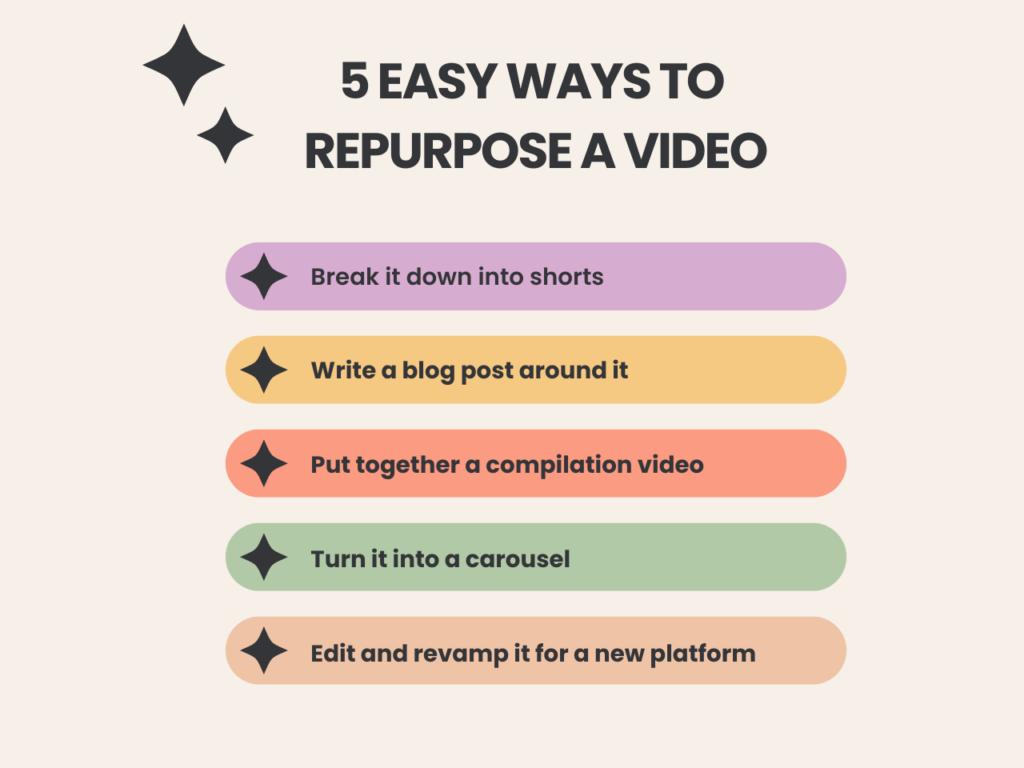
Think about it practically. If you’ve made a video about the top ten sites to see in a city, that’s actually ten separate short videos waiting to happen. It’s a compilation. It’s a carousel post for Instagram or a series of Facebook posts. It’s a blog article or a Reel with highlights pulled from footage you’ve already shot. One piece of content can stretch a lot further than most creators realize, and finding those angles is a skill worth developing. Buffer has a great guide on how to repurpose content in a meaningful way across different platforms.
Compilation videos are a particularly good example of repurposing done well. It’s not new footage, but audiences genuinely find it useful. If someone is planning a trip and wants to go deep on everything you’ve covered about a destination, having it all gathered into one place saves them from hunting through your entire channel. You’re adding real value without adding much production time, which is worthwhile on days you’re running low on time and ideas. It is also a good reminder that strong content doesn’t always require starting from scratch!
The broader point is that repurposing allows good work to get a second life and reach new audiences that might’ve missed it the first time around. Audiences are always growing and changing, and something you posted a year ago could be genuinely new to many people following you today, and even if not, it can be a great refresher!
4. Look at What Your Competition Is Doing, Then Make It Yours
This one comes with an important caveat: there is a real difference between copying and interpreting, and it’s worth understanding before you dive in.
Scroll through your industry and pay attention to what formats and topics are gaining traction. Maybe food creators are making “what I ate in 48 hours in Paris” videos and those are genuinely taking off. That’s worth paying attention to! The question is then how you would approach that same concept through your own lens. Your experiences and your perspective are what transform someone else’s format or idea into your own original piece of content.
This is how creative industries work and always have. A musician hears a chord progression that moves them and writes something new inspired by that feeling. A filmmaker watches a scene that lingers and thinks about how they would have told that story differently. Creators have always built on what came before them, and there’s nothing wrong with that as long as you’re genuinely adding something of your own to it. Canva describes this in their own list of tips and tricks to deal with a creative block: https://www.canva.com/learn/creative-block/.
When you’re browsing your competition for inspiration, search for a spark. See what evokes your own emotions or memories and follow that. The goal is to let someone else’s work point you toward a direction, then go somewhere with it that only you could. The strongest content that comes from this process usually ends up looking nothing like the original idea that started it, because by the time your own voice and experiences shape it, it becomes something entirely different.
5. Build a Repeatable Process or Weekly Theme
One of the best long-term defenses against creator’s block is having a structure you can fall back on no matter what. If you know that Mondays are for motivational content and Tuesdays are travel-focused, you never have to start from zero.
For travel creators specifically, having a reliable format helps a lot. Knowing that every new destination gets a “what not to do” video and a “what to eat” video means you show up to every trip with at least two videos already mapped out before you’ve filmed a single second. The structure does the heavy lifting, so your brain doesn’t have to.
Your audience also begins to expect and look forward to recurring formats, and that’s a good thing. It builds a rhythm and gives people a reason to keep coming back, not just when a video happens to show up in their feed. Think of it like a TV show: people tune in because they know what they’re getting, and they love it.
Weekly themes also create a great framework for planning ahead. When you know what type of content is coming on a given day, building out a running list of potential ideas for each slot becomes much more manageable. That kind of advance planning brings a level of stability to your schedule that’s hard to achieve when you’re generating ideas and filming in the same week. Content that has had time to be refined and be properly finished almost always shows it, and your audience will notice the difference between something carefully put together and something rushed out to fill a gap.
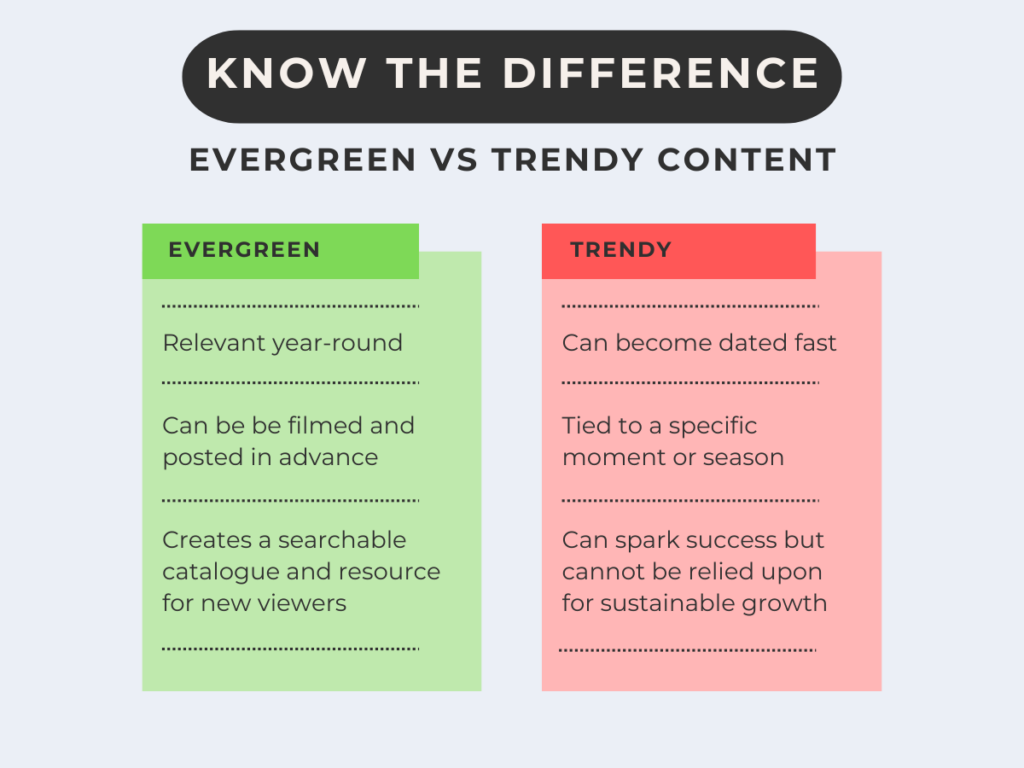
Having a few video ideas saved for a rainy day can be a genuine lifesaver, and that’s where evergreen content comes in. Evergreen ideas are videos that don’t rely on trends or seasonal timing. They stay relevant and useful year-round, meaning they can be filmed and published whenever you need them without feeling out of place.
Building a small stash of evergreen ideas is a habit worth developing early. When creator’s block hits and the pressure is on, having a handful of solid concepts already sitting in your notes app gives you a starting point. Think of it as a content safety net for the harder days.
The key to finding good evergreen ideas is learning to distinguish between what’s topical and what’s trendy in your niche. Trendy content performs well in the moment but quickly fades in relevance. Topical content answers questions that your audience will have regardless of the season. A travel creator making a video about the best hidden restaurants in Rome will find that content just as relevant in January as in July. A video about Christmas markets abroad, however, has a much narrower window.
So, when a burst of creativity does strike, consider saving some of it. Write down the ideas that have no expiration date and save them for the days when inspiration needs a little more time to flow.
6. Create Content About What You’re Actually Going Through
This is the meta tip, and one of the most underrated ones on this list. When you can’t figure out what to make, make that. Document the struggle. Take your audience behind the scenes and show them what it actually looks like to be a content creator on a bad brain day.
Audiences, especially younger ones, are hungry for authenticity. They don’t just want the polished final product; they want to see the process and the real version of what you do. A video about sitting in a park for an hour trying to figure out what to film, and then working through it in real time, is genuinely compelling. It’s relatable. It makes you human.
Behind-the-scenes content builds connection in a way that highly produced videos sometimes can’t. So, the next time you’re stuck, instead of spiraling, just hit record and talk about it. You might be surprised how much people appreciate the honesty.
These videos can even just cover the content making process. Describe your process for generating ideas, but then show what happens when you actually put pen to paper. Audiences enjoy getting a peek behind the curtain when it comes to filming, editing, and posting.
The Bottom Line
Creator’s block is real, and it happens to everyone. It doesn’t matter how long you’ve been creating, how big your audience is, or how inspiring your surroundings are. You can be standing in one of the most beautiful cities in the world with a camera in your hand and still feel completely stuck. That’s just part of the process.
The important thing to remember is that it’s always temporary. Every creator you admire has sat in the same spot you’re in right now, staring at a blank page or an empty timeline, wondering where the next idea is going to come from. What separates the ones who grow from the ones who stall is the willingness to keep pushing even when the ideas aren’t flowing freely.
So, when it hits, come back to some of these tips. Search for the spark wherever it may come from and follow your intuition. Now get back out there and create!
Additional Resources:
YouTube Analytics – https://support.google.com/youtube/answer/9002587?hl=en&co=GENIE.Platform%3DDesktop
TikTok Creator Search Insights –
https://www.tiktok.com/support/faq_detail?id=7581820708318239243&category=web_account
Canva Creative Block – https://www.canva.com/learn/creative-block/
Buffer Repurposing Content – https://buffer.com/resources/repurposing-content-guide/