Boomer to Zoomers: Navigating the Generational Marketing Landscape
Boomer to Zoomers: Navigating the Generational Marketing Landscape
By Hannah Jagers
Hannah Jagers is a senior at the University of Illinois’ Gies College of Business specializing in strategic marketing and corporate communications.
Understanding the “Why” Behind the Buy
As marketers, we aren’t just selling products; we are selling solutions to specific groups of people known as generational cohorts. These are groups of people born within the same timeframe who share general characteristics, values, and purchasing habits based on the world they grew up in. While every individual is obviously unique, understanding these broad strokes allows us to tailor our communication and product offerings to resonate more deeply with our target audience’s specific needs. It’s about moving past a “one-size-fits-all” mindset and recognizing what feels like a necessity for one group might feel like a luxury to another.
Whether you are trying to reach a tech-native “Zoomer” or a brand-loyal Senior, your strategy has to adapt to the unique “worldview” of that generation. In this blog, we will break down the five major cohorts and look at how we can connect with them in a way that feels authentic rather than intrusive. By the end of this deep dive, you’ll see that successful marketing isn’t about manipulation, but about speaking the same language as your customer. After all, the better we understand the “why” behind their choices, the easier it becomes to build a brand they can trust.
1. The Seniors (Born before 1946)
Often retired and living on fixed incomes, Seniors are characterized by their immense, deep-seated brand loyalty that spans decades. They tend to prioritize necessity and value above all else, often spending significantly more time deliberating over a single purchase to ensure they are getting the absolute best possible deal for their money.
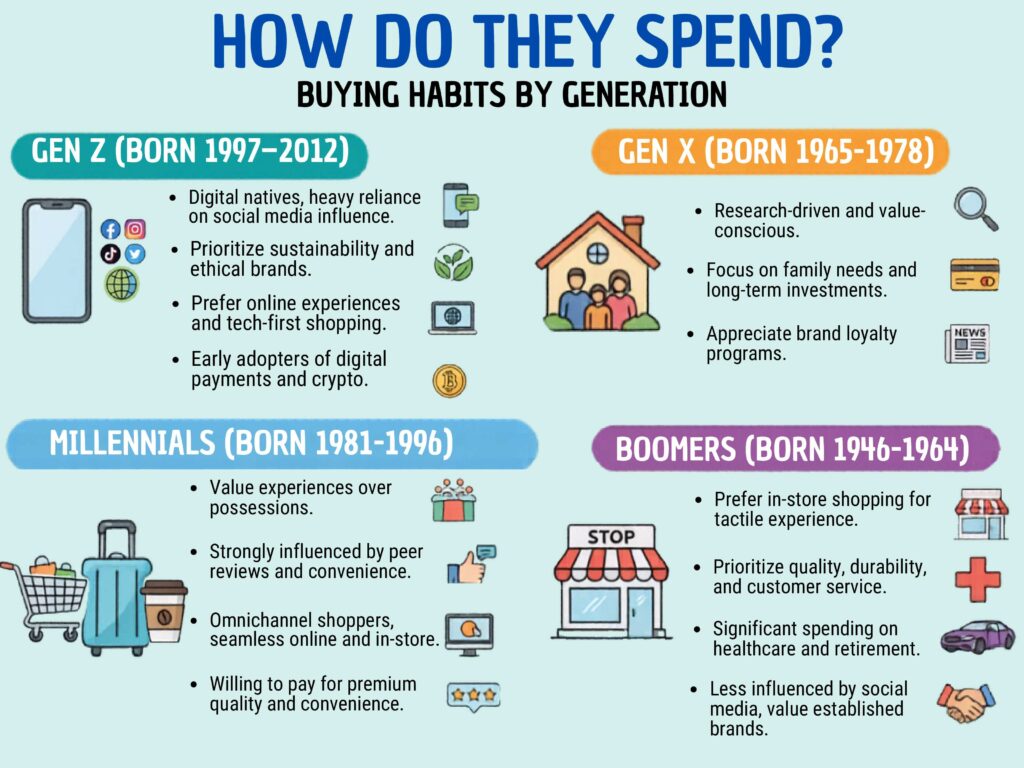
For this generation, a “Buy American” label isn’t just a marketing slogan; it is a profound influence on their purchasing decisions and a reflection of their personal values. They truly value stability and consistency in the products they bring into their homes, believing that if they find a brand that works, there is no reason to ever look elsewhere. Because they generally grew up in a world that was less “disposable” than ours, they expect products to last and companies to stand by their word. This group is also generally slower to adopt new technology, so they appreciate clear, patient communication and a human touch when digital tools are involved.
2. Baby Boomers (1946–1964)
The Baby Boomers represent one of the largest and most influential demographics in history, having shaped consumer culture for decades. As they transition into retirement, many are shifting their focus—and their spending—toward leisure and personal self-fulfillment, investing in things like second homes, sports cars, and bucket-list travel.
Boomers are highly individualistic and generally want to feel like they are the center of the story when interacting with a brand. They also maintain a strong “forever young” mentality, which has fueled massive growth in industries like premium skincare, boutique fitness, and vitality supplements. Unlike the Seniors before them, who often prioritized frugality, Boomers are frequently willing to spend on “wants” rather than just basic “needs” as they look to truly enjoy the fruits of their hard-earned retirement. They aren’t just looking for products that work; they are looking for products that help them maintain their active, vibrant lifestyles well into their later years.
3. Generation X (1965–1980)
Gen X essentially grew up in the ultimate transitional era, caught between the analog world of their parents and the digital explosion to come. Often remembered as the “latchkey kids” because they were the first generation where it was standard for both parents to be out at work; they developed a fierce sense of independence and a naturally healthy dose of skepticism toward authority.
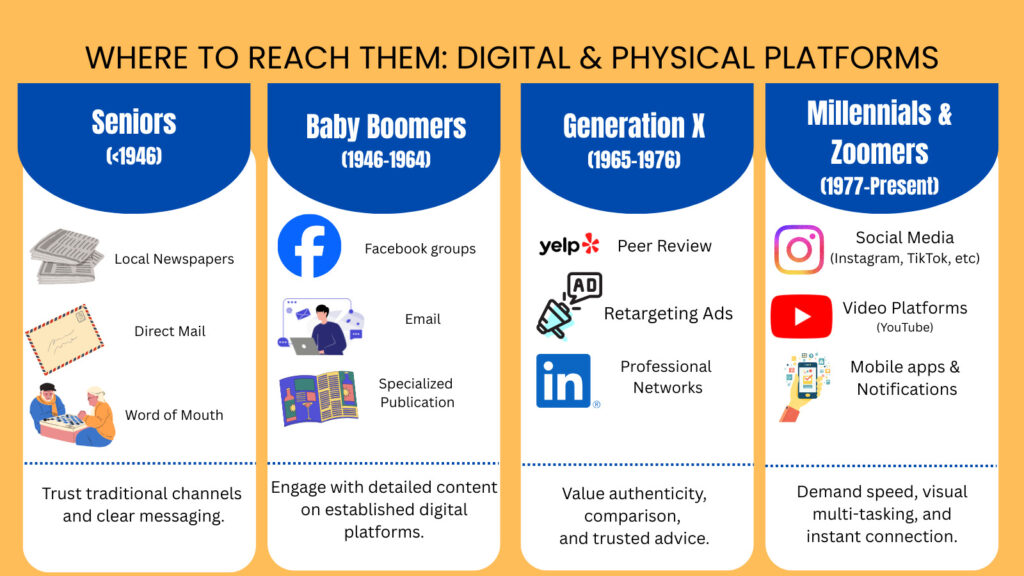
Because of that upbringing, they don’t usually buy into traditional “polished” advertisements or corporate promises. Instead, they rely heavily on the “real story” found in peer reviews on platforms like Yelp or TripAdvisor before they ever open their wallets. They are currently the “sandwich generation,” often feeling a significant financial squeeze as they balance the costs of raising their own children while caring for their aging parents. This unique pressure makes them incredibly practical and value-oriented shoppers who aren’t looking for fluff; they want products that solve real problems without the marketing hype.
4. Millennials (1981–2000)
Millennials are essentially pioneers of the work-life balance movement. For them, a career isn’t just about the paycheck; it’s about the overall experience and finding a sense of purpose in what they do. This is the generation that brought “YOLO” (You Only Live Once) and “FOMO” (Fear of Missing Out) into the mainstream, reflecting a deep-seated desire to make the most of every moment.
As digital natives who grew up right as the internet was exploding, they are incredibly tech-savvy and famous for multitasking across several platforms at once. Because they’ve seen technology evolve so quickly, they value speed and convenience above almost everything else in a digital experience. If a website takes more than three seconds to load, you’ve likely already lost their attention to something faster. They don’t just want things to work; they want them to work instantly so they can get back to the experiences that matter to them.
5. Gen Z / Zoomers (2001–2015)
Zoomers have never known a world without the internet. They are the most technologically integrated generation yet, often having used mobile devices since they were toddlers. This constant connectivity has made them hyper-aware of global trends and social issues in a way previous generations weren’t at the same age.
Because of this, they can seamlessly juggle a college lecture, a mobile game, and three different social media feeds all at once without breaking a sweat. While they are individualistic like the Boomers, they are also deeply value-driven and prioritize social responsibility and family orientation above “cool” branding. To reach a Zoomer, your brand absolutely has to be authentic and have a “soul.” This generation looks past the corporate facade to see if a company’s actions align with the ethical standards they promote online, and they aren’t afraid to call out brands that feel performative.
Strategic Deep Dive: The Evolution of Trust and Content
The Cognitive Cost of Constant Connection
The Millenial Workforce: How Multitasking is Changing Our Brains
While we often wear our ability to multitask as a badge of honor, research highlighted by Caroline Beaton in Forbes suggests that this constant switching is fundamentally altering the millennial and Gen Z brain. The article explores how our obsession with “keeping up” across multiple digital channels, what we might call the FOMO effect, is decreasing our cognitive control and making us more susceptible to interference from irrelevant information.
From a marketing perspective, this is a gamechanger. It means our target audience isn’t just “busy”; their brains are literally being rewired to favor short-term stimulation over long-term focus. If our content doesn’t hook them within the first few seconds, it becomes the “irrelevant interference” their brains have learned to filter out. This explains why traditional, long-form advertising is struggling to gain traction with younger cohorts. We aren’t just competing with other brands; we are competing with the brain’s new physiological habit of seeking the next hit of dopamine from a different app or tab. To build trust now, we must provide immediate, high-value content that respects this new cognitive reality, rather than trying to force an old-school attention span on a generation that has moved past it.
Why Boomers Stay while Zoomers Stray
Boomers show more Brand Loyalty than younger Generations
While multitasking is redefining younger generations, Baby Boomers remain the “reliability of anchor” of our economy. According to EMARKETER, Boomers show the highest brand loyalty across almost every category, especially in groceries, where nearly 76% identify as brand loyal. For them, trust isn’t a fleeting emotion sparked by a viral trend; it’s a long-term investment built on a proven track record and consistent quality.
This creates a fascinating strategic divide. While Gen Z and Millennials, influenced by the “distraction-heavy” neural pathways mentioned in the Forbes piece, have essentially become professional brand-switchers, Boomers see loyalty as a tool for financial stability. They are “patient researchers” who value the dependability of names like Toyota or Honda because those brands reflect their own values of smart spending.
As a marketing student at Gies, the lesson is clear: we have to manage two completely different trust models at once. To win over a Boomer, you emphasize heritage and quality. To win over a Zoomer, you must cut through the noise with immediate, high-impact authenticity. It’s easy to get swept up in the excitement of TikTok, but Boomers still hold over 50% of U.S. wealth. The “old” marketing values of reliability and trust are still where the massive, consistent purchasing power sits.
The Emotional Anchor: Leveraging the Psychology of Nostalgia
The Psychology of Nostalgia
While EMARKETER tells us who is buying, psychology explains why those purchases actually happen. According to Psychology Today, nostalgia isn’t just a “blast from the past”; it’s a functional tool we use to boost our mood and confidence when life gets stressful. For marketers, this is a massive insight, especially when comparing Boomers to Zoomers.
For Baby Boomers, nostalgia acts as a “retrieval cue” for stability. When brands like Coca-Cola or Ford use vintage aesthetics, they aren’t just selling a product; they’re offering a way to dampen modern-day stress by reconnecting consumers with a version of themselves that felt more secure. Since nostalgia often happens around friends and family, it’s a powerful way to build multi-generational trust.
On the flip side, Gen Z is driving the rise of “Newstalgia.” Even though they didn’t live through the 90s, they use retro triggers to find meaning and optimism. As a Gies student, I see this as a call to action: we shouldn’t just use “old stuff” for the sake of being “retro.” Instead, we should use nostalgia to provide that genuine emotional boost. Whether it’s helping a Boomer relive a memory or helping a Zoomer find comfort in a “simpler” aesthetic, understanding the psychology of reminiscing turns intrusive advertising into real storytelling.
Conclusion: Meeting Them Where They Are
The most important takeaway for any marketer is that you cannot use a one-size-fits-all approach. To succeed today, you must meet your audience where they live—whether that’s a local newspaper for a Senior, a Facebook group for a Boomer, or a TikTok feed for a Zoomer. By understanding these generational cohorts, we can stop shouting into the void and start building genuine connections with our customers.
Moving forward, the challenge for brands lies in “generational fluidity.” While these cohorts provide a necessary baseline for strategy, we must also recognize that digital literacy is increasing across the board. A Boomer who uses Facebook to stay connected with grandkids might also be susceptible to Instagram ads for travel, just as a Zoomer might appreciate the tangible, high-quality “vintage” feels of a physical brand catalog. The key is to use these generational profiles as a compass, not a cage.
As we have explored, the shift from the Seniors’ brand loyalty to the Zoomers’ value-driven multitasking reflects a broader societal shift toward authenticity. Modern consumers, regardless of age, are becoming increasingly adept at filtering out “corporate noise.” Therefore, the successful marketer of the future will be the one who respects the historical context of their audience while leveraging the specific technological tools they trust most. By aligning our brand’s voice with the unique worldview of each cohort, we transform a simple transaction into a lasting relationship, ensuring our marketing efforts are not just seen, but felt and acted upon. Consistent engagement across these varied touchpoints is what will ultimately define the next era of professional brand management.