Get More Clicks on Content Without Clickbait
Get More Clicks on Content Without Clickbait
Jerome Phillips
Jerome Phillips is a business student passionate about marketing strategy, branding, and helping young professionals turn classroom knowledge into real-world impact.
How to Get Clicks on Your Videos, Blogs, & Posts
Let’s be honest.
You’ve probably posted something you were proud of… only to get five likes, two of which were your friends, and one was your mom.
It’s frustrating. You know you put time into it. You thought it was valuable. So why didn’t anyone click? You’re not desperate for attention, but you cared.
- You put thought into that post.
- You believed it had value.
- You hoped it would resonate with someone.
Instead, it got buried under an overload of other videos, blogs, reels, tweets, and updates flooding platforms like YouTube, Instagram, TikTok, and LinkedIn.
Here’s the truth no one says out loud: good content alone is not enough.
Every scroll is a decision. Every second, someone chooses if you are worth their time or not.
That sounds harsh, but it’s also empowering.
Because clicks are not random.
- They are reactions to clarity.
- They are responses to relevance.
- They are signals of trust.
When someone clicks on your video or blog, they are saying, “I believe this might help me.” That belief doesn’t happen by accident. It happens when your message feels personal, intentional, and valuable.
For college students and recent graduates, this matters more than we realize.
Whether you’re building a personal brand, applying for jobs, launching a side hustle, or simply trying to share ideas, your digital presence speaks before you do.
- The question is NOT, “How do I get more clicks?”
- The question IS, “How do I create content that deserves attention?”
This blog expands on those ideas and reframes them for students and young professionals who want to grow with integrity.
Because attention is not about going viral.
- It’s about being valuable.
- That starts with intention.
In Professor Walters’ video, “How to Get Clicks on Your Videos, Blogs, & Posts,” he breaks down something every young marketer, entrepreneur, and content creator needs to understand: there is no magic formula, but there are proven principles that dramatically increase your chances of getting attention.
And in today’s world, attention is everything.
This blog expands on those principles and explains how you, as a college student or recent graduate, can use them to create content that actually gets clicks and builds credibility.
Why Clicks Matter More Than You Think
Before we talk tactics, let’s talk reality.
Clicks are not just metrics. They are signals.
When someone clicks:
- They are curious.
- They believe there is value for them.
- They trust your headline or thumbnail enough to give you their time.
In digital marketing, time is currency. If you cannot get someone to click, they will never see your value.
That means:
- Your blog won’t be read.
- Your video won’t be watched.
- Your product won’t be considered.
- Your brand won’t grow.
Getting clicks is the first step in every digital relationship.
1. Speak Directly to Your Target Audience
One of the biggest mistakes young marketers make is trying to talk to everyone.
If you talk to everyone, you reach no one.
Professor Walters emphasizes that your content must feel personal. If someone feels like you are speaking directly to them, they are far more likely to pay attention.
Think about it. If someone yells “Hey!” in a crowded room, I’ll ignore it.
If someone says “Jerome,” I’ll turn my head.
That is how specific your content needs to be.
Ask Yourself:
- Who is this post really for?
- What age range?
- What stage of life?
- What problems are they facing?
- How do they communicate?
If you are targeting college students, your tone should feel relatable and practical.
If you are targeting mid-career professionals, your tone should be more strategic, and results driven.
Platform Matters
Different audiences live on different platforms.
- Younger audiences often use Instagram, TikTok, and YouTube.
- Older demographics may prefer Facebook.
- Professionals gravitate toward LinkedIn.
If you are creating amazing content but posting it where your audience does not spend time, you are basically speaking into the void.
Marketing research matters. Even at a student level, you can:
- Look at analytics.
- Observe engagement patterns.
- Study competitors.
- Analyze trending formats.
The more you understand your audience, the more your content will resonate.
2. The Hook: What’s In It For Me?
Every person scrolling through their phone is subconsciously asking one question:
“What’s in it for me?”
If your title, thumbnail, or first sentence does not answer that question, they keep scrolling.
A strong hook does at least one of these things:
- Solves a problem.
- Sparks curiosity.
- Promises value.
- Triggers emotion.
- Offers something useful.
For example:
Weak title:
“Social Media Tips”
Stronger title:
“How to Get More Clicks on Your Posts (Even If You Have 200 Followers)”
The second one speaks directly to a specific frustration.
Make Benefits Clear
If you are writing about travel, say what someone will gain.
If you are writing about marketing, say what skill they will improve.
If you are writing about productivity, say what result they will achieve.
Never assume people will figure it out.
Spell it out.
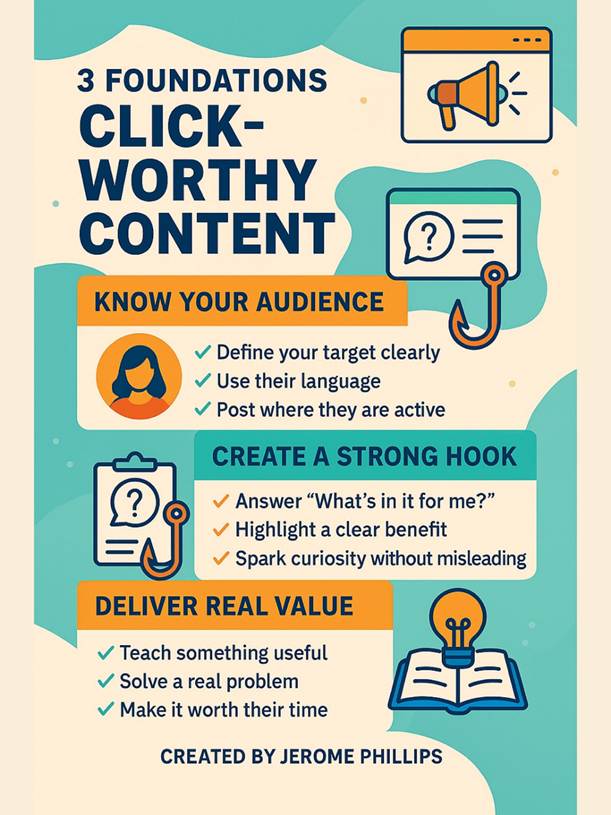
3. Content is King (But Only If It’s Good)
You can have the best thumbnail in the world.
You can have a powerful headline.
But if your content disappoints, people will not return.
And worse, algorithms will notice.
When someone clicks and immediately leaves, that tells platforms your content is not valuable. Over time, your reach decreases.
That is why Professor Walters stresses: do not create clickbait.
Clickbait might get the click once.
Value gets loyalty.
As young professionals building our reputations, credibility matters more than short-term attention.
If you promise:
- “5 Ways to Get More Clients”
Then actually give five detailed, useful ways.
The goal is not just clicks.
The goal is trust.
4. Don’t Get Stale
Even great content can become boring if it never evolves.
Think about your favorite childhood show. At some point, you outgrew it. Why? Because it stopped feeling new.
The same thing happens with content.
If you:
- Post the same format every time
- Use the same structure
- Repeat the same themes
- Avoid experimenting
People lose interest.
Ways to Avoid Boredom:
- Mix videos with static posts.
- Add polls or interactive questions.
- Use infographics.
- Try short-form and long-form content.
- Change visual backgrounds.
- Tell stories instead of just teaching.
Variety keeps audiences engaged.
As students, this also shows adaptability, which is a valuable professional skill.
5. Thumbnails, Titles, and First Impressions
First impressions are digital gatekeepers.
Before someone reads your blog, they see:
- The title
- The thumbnail
- The preview image
These must:
- Be visually clear
- Be easy to read on mobile
- Match the content
- Spark curiosity
Your thumbnail should not:
- Be cluttered
- Use tiny text
- Mislead viewers
If someone feels tricked, they will not return.
Think of your thumbnail like packaging. It should represent what is inside, not exaggerate it.
6. Use Alt Text and SEO to Increase Discoverability
This is where many beginner content creators miss opportunities.
When you upload an image, you can add alt text. This is a short description of what the image shows.
Why does that matter?
Because:
- Search engines read it.
- It improves accessibility.
- It increases the chances of appearing in image search.
For example:
Instead of uploading “image1.jpg,” use descriptive text like:
“Downtown Cheyenne Wyoming travel scene”
Small details compound over time.
SEO is not just about stuffing keywords. It is about clarity, relevance, and consistency.
7. Visuals Matter More Than You Think
When scrolling through Instagram or LinkedIn, what makes you stop?
Usually:
- Bold visuals
- Clean graphics
- Interesting data
- Strong contrast
Infographics are powerful because they:
- Simplify complex ideas
- Make information shareable
- Increase engagement
- Improve retention
Young audiences especially respond to visual learning.
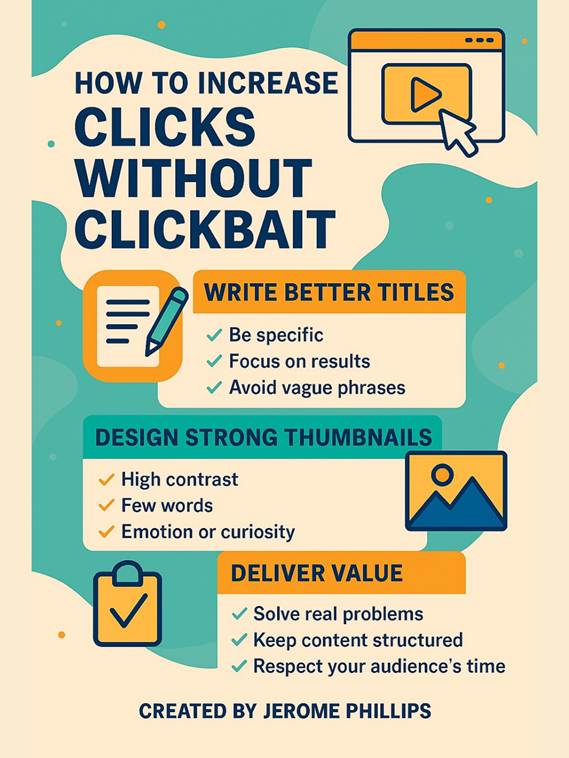
8. Consistency Builds Momentum
You cannot post once and expect traction.
Digital growth requires:
- Repetition
- Testing
- Refinement
That is why A/B testing titles matters. Small changes can significantly affect clicks.
For example:
“How to Get More Clicks”
versus
“How to Get 3X More Clicks on Your Posts”
Both are clear, but one is more specific and measurable.
Testing helps you learn what your audience responds to.
9. What This Means for College Students and Recent Graduates
If you are trying to:
- Build a personal brand
- Grow a LinkedIn presence
- Launch a side hustle
- Start a YouTube channel
- Create a business blog
These principles apply directly to you.
Getting clicks is not about being loud.
It is about being relevant.
When you:
- Speak directly to your audience
- Offer clear value
- Present content professionally
- Stay consistent
- Avoid clickbait
- Keep evolving
You build something sustainable.
As young professionals, we are not just chasing views. We are building reputations.
Stop Posting, Start Strategizing
Posting randomly is easy.
Strategic posting takes thought.
Before you hit publish, ask:
- Who is this for?
- Why should they care?
- Is my title clear?
- Is my thumbnail compelling?
- Am I delivering real value?
Clicks are earned, not given.
The students and young professionals who understand this early will stand out in the digital world.
And the best part? You do not need a huge following to start.
You just need intentional content.
Conclusion: More Than Clicks, It’s Connection
At first glance, getting clicks seems like a numbers game.
- More views.
- More impressions.
- More engagement.
But when you step back, you realize it’s something deeper.
Every click represents a person.
- A person who paused their scrolling.
- A person who chose you.
- A person who believed, even briefly, that what you shared was worth their time.
That’s not small.
Throughout this blog, we’ve explored strategy: knowing your audience, crafting stronger hooks, designing better thumbnails, delivering real value, and staying consistent. These tools matter. They increase visibility. They improve performance.
But strategy without empathy feels fake.
The real shift happens when you stop asking, “How do I get more clicks?” and start asking, “How do I serve my audience better?”
- When you speak directly to someone’s struggle, they feel seen.
- When you clearly explain the benefit, they feel understood.
- When you deliver what you promise, they feel respected.
That’s how trust is built.
And trust compounds far longer than hype ever will.
As students and young professionals, we are building more than social feeds. We are building reputations. Digital footprints. First impressions that may follow us into internships, careers, partnerships, and opportunities we cannot yet see.