Understanding Marketing Math: Basic Marketing Math That Every Marketer Should Know
By Daniel Velazquez-Brito – Marketing Enthusiast & Statistics Lover
The Business Numbers Every College Student Should Know
When you think of marketing, the first thing that comes to mind is usually anything but math and numbers. Marketing is often seen as the creative side of a business rather than its financial backbone. People tend to associate marketing with social media campaigns, advertisements, brand awareness, and influencer partnerships. With that said, creativity does play a key role in this division, as the goal of marketing is to attract customers and build a strong brand identity. However, there is another side of marketing that is just as important but receives far less attention. Numbers play a key role in the decisions being made behind closed doors and in examining results.
The math behind marketing helps tell the story of a business and the direction it is heading. It can show whether a company is growing steadily, falling behind competitors, losing money, or making a profit. Nearly every business decision connects back to math. There is no point in having the most “out-of-this-world campaign for a new Pepsi flavor” if the costs exceed the gains and awareness a company hopes to achieve from the campaign.
Therefore, a marketing campaign must prove that it delivers measurable results. A company cannot simply rely on funny trends and wacky commercials to strengthen the brand’s position in the market. Numerical analysis is crucial, as guessing what might create an emotional connection is risky when large investments of money are involved. Every step must be calculated to achieve proper efficiency.
In the video “Basic Marketing Math That Every Marketer Should Know,” Professor Wolters explains that marketing math may not be the most exciting topic for students in the field of marketing, but it is a necessary skill that will be valued in their careers. Students learn how companies survive and grow by understanding the numbers behind them. The question that marketers must be able to answer is…
- How much revenue is required to keep the company?
- How much product must be sold to become profitable?
- Which line of products performs the best?
- How well is the company doing compared to the entire market?
- How well is the company doing in comparison to our direct competition?
- Are the campaigns worth the money being spent?
These are not opinion-based questions. They require clear calculations and measurable metrics. Marketing math provides managers with objective information so they can make smart, data-driven decisions rather than relying on assumptions.
For college students, understanding marketing math provides a professional advantage when presenting work to bosses, associates, or coworkers. Regardless of whether you are in the field of marketing, finance, consulting, or management, having basic numerical literacy helps individuals make smarter decisions and communicate more effectively in professional environments. Employers value candidates who understand both creativity and analytics because modern businesses rely heavily on data.
This blog explains the most important marketing formulas in simple, straightforward language so students can understand how businesses measure performance and profitability.
Total Costs: Understanding Business Expenses
Every company has expenses that must be paid to operate, which makes up a company’s total cost. The first is fixed cost and the second is variable costs.
Fixed costs are expenses that do not change based on how much a company produces or sells. These costs must be paid regardless of business performance. Examples of fixed costs include mortgage, equipment leases, insurance payments, software subscriptions, and utility bills. These costs are a constant rate, that do not change regardless of monthly sales, weather, or production delays. Fixed costs help businesses plan long-term budgets and financial strategies, as they are predictable.
Variable costs change depending on production or sales levels. The more products a company makes or sells, the higher the variable costs become. These costs include raw materials, packaging supplies, shipping fees, sales commissions, transaction processing fees, and hourly labor for production staff. Variable costs could be difficult to budget as they can constantly change, making them hard to precisely predict.
The formula for calculating total cost is:
Total costs = Fixed Costs + Variable Costs
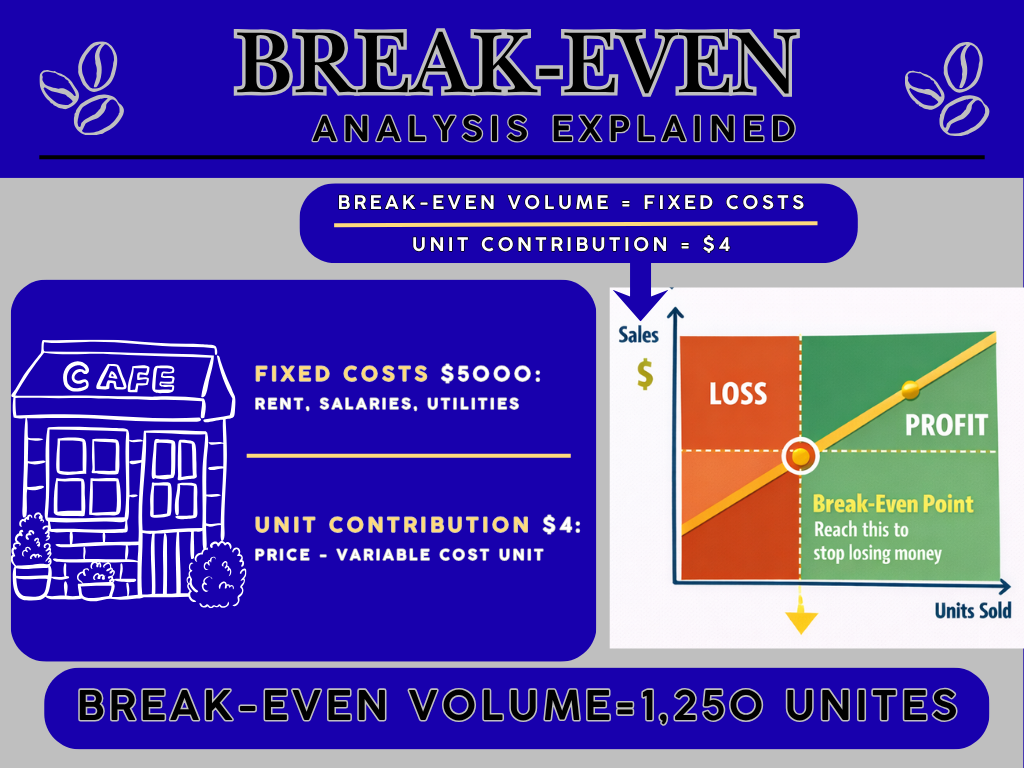
For example, imagine your local coffee shop located near your main quad. The coffee shop must pay $5,000 per month for rent, utilities, insurance, and equipment leases. This is an expense that will never change throughout the year, regardless of customer traffic in the summer, fall, or winter. So, they have fixed costs for the coffee shop.
The Coffee Shops also need to purchase supplies that need to produce each drink. The ingredients needed are coffee beans, milk, syrups, plastic cups, paper cups, and lids which approximately cost $2 per drink. If the shop sells 3,000 drinks in a month, the variable costs a total of $6,000.
Meaning total costs = $5,000 + $6,000 = $11,000 (INSERT INFOGRAPHIC 1)
Understanding the total cost helps business determine the minimum revenue required to remain operational as it answers the question of “what it going to cost to keep us in
business?” Companies can risk underpricing products or overspending on operations if they do not have a sense of what their total cost is.
Profit and Loss: Determining Business Success
After total costs are calculated, companies then analyze whether they are profitable by adding their total revenue and subtracting their total costs, which gives them their profit or loss.
Profit (or Loss) = Total Revenue – Total Cost
If the result is positive, the business earns a profit and if the result is negative, the business experiences a loss.
For Examples if the coffee shops monthly revenue reaches $15,000
Profit = $15,000 – $11,000 = $4,000 profit
However, during university breaks, the revenue drops to $9,000
Profit = $9,000 – $11,00 = -$2,000 loss
This highlights the importance of not just generating sales, but generating enough revenue to cover operating expenses. Although this math is not rocket science, it is extremely important, as many new businesses fail or struggle despite strong sales numbers. This often happens because owners underestimate operating costs and misprice their products. Profit analysis helps ensure that companies understand their true financial position, rather than assuming they are successful simply because of high sales. Without this understanding, businesses may add new trendy drinks to their menu without knowing their actual costs.
Unit Contribution: Measuring the Value of Each Sale
Not every dollar of revenue becomes profit. A portion of each sale must cover production costs before contributing toward fixed expenses and profit. Unit contribution gives you an idea of how much each sale goes toward profit or toward covering costs.
Unit Contribution = Price – Variable Cost per Unit
If a coffee shop sells each drink for $6 and the variable cost is $2 per drink, then the unit contribution is $4. Each drink sold contributes $4 toward covering rent, salaries, utilities, and eventually profit. This shows how much each individual sale helps the business and helps determine its target sales goals.
If the unit contribution is low, the company must sell a higher volume of products to break even. However, if the unit contribution is high, fewer sales are needed to become profitable. Common tactics companies use to improve their unit contribution include raising prices, negotiating cheaper supplier contracts, or redesigning products to reduce material costs.
Contribution Margin: A Percentage Perspective
Contribution margin is the ratio that shows how much a sale contributes to profits or to covering total costs relative to its price. It expresses unit contribution as a percentage of the product’s price, making it easier to compare different products.
Contribution Margin = (Price – Variable Cost) / Price
For example, if a customer pays $6 for a coffee and the cost to make that drink is $2, then:
Contribution Margin = ($6 – $2) / $6 = 67%
This means that 67 percent of the revenue from each drink can go toward covering fixed costs and generating profit. If a customer pays $6 for a drink, about $4 of that payment helps the business operate and earn profit, while only $2 covers the cost of making the drink. In other words, 33 percent of the revenue goes toward production expenses.
Businesses prefer higher contribution margins because they create financial flexibility, allow faster scaling, and provide protection during slow sales periods.
Brand Growth Rate: Tracking Business Momentum
Brand growth rate measures how quickly a company’s sales are increasing or decreasing over a period of time. The brand growth rate focuses on the direction the business is moving rather than the revenue from a single period. This helps tell a story about the overall business momentum a company is experiencing.
Growth Rate = (Sales this period – Sales last period) / Sales last period
For example, if annual sales increase from $200,000 to $260,000, then using the formula, a company will find that the growth rate is 30%. This means that the company’s sales grew 30 percent compared to the previous year.
Positive growth indicates effective business management and successful marketing strategies. It suggests that more customers are buying the products and that the company is building customer loyalty. Companies that maintain steady positive growth are often seen as successful.
Negative growth indicates that sales are declining from one period to the next. This can serve as a warning sign for companies to act and change something within their business model. It forces managers to investigate the cause and adjust strategies, such as launching promotions or targeting new customer segments. Negative growth could result from reduced demand, intense competition, or poor marketing performance.
Market Share and Competitive Position
Market share measures how much of an industry’s total sales belong to one company. It looks at a firm’s success in the marketplace and shows how well it is doing compared to the entire market.
Market Share = Company Sales / Total Industry Sales
For example, if the shoe industry generates $500 million in total sales and Adidas sells $50 million worth of shoes, you can find the market share by simply plugging the numbers into the equation. This shows that the company controls 10 percent of the total market.
Understanding and knowing your market share can influence your bargaining power when negotiating strong deals with suppliers and retailers. This can help increase profit margins and make it harder for competitors to enter the market and gain a strong share.
However, it’s important to note that market share is not just about being the biggest company. A company might grow in sales but still lose market share if the industry is growing faster. For example, even if a company’s sales increase by 5 percent, if the industry grows by 15 percent, then the company’s positioning is actually weakening.
Why Marketing Math Matters for College Students
Understanding marketing math gives students a strong competitive advantage as they progress into their professional careers. Marketing professionals use these metrics to justify budgets, evaluate campaign performance, and guide strategic decisions. Entrepreneurs rely on them to set prices, avoid losses, and forecast growth. Analysts use them to evaluate company performance and guide investment decisions.
Employers are looking for candidates who can combine creativity with analytical decision-making. Marketing math gives you the necessary tools to measure performance and justify strategies, which can help boost impressions during campaign pitches because you have the knowledge to back up your claims with data.
Marketing math also builds confidence, as many students feel intimidated by financial topics due to the vocabulary of the field and the technical nature of some concepts. The core of these ideas can be broken down into simple formulas that make them easier to understand. Therefore, becoming comfortable with these topics helps students feel more prepared for internships. When you sit in team meetings where terms like unit contribution, variable costs, and contribution margin are frequently discussed, being able to keep up with and participate in the conversation is what sets interns apart and can lead to return offers.
In today’s data-driven world, businesses value employees who can interpret numbers and use them to make smarter decisions at any level of the management chain. Therefore, students who understand marketing math stand out because they can connect creativity and strategy with evidence and measurable outcomes.
Marketing Math does not seem excited at first, but it created the success behind every advertisement, product launch, and brand Strategy. As it used financial analysis to understand calculation like total cost, growth metrics and investment returns. Numbers tell the real story of business performance.