SWOT Analysis Explained Correctly: Why Most People Do It Wrong (And How to Fix It)
By Aalya Masud
Marketing student at the University of Illinois Urbana-Champaign interested in digital strategy, branding, and content creation.
Introduction: The Problem with SWOT Analysis
So, if you’ve ever had any kind of business or marketing course, you’ve probably done a SWOT analysis at some point. It’s just one of those things that seems really straightforward, so you just list out the strengths, the weaknesses, the opportunities, and the threats, and then you move on.
But after watching Professor Wolters’ video, I learned that most people, including myself at times, don’t actually use the SWOT analysis in the way that it’s supposed to be used.
Instead, we tend to just use it as a checklist.
We list out a bunch of points, turn it in, and that’s it. But the whole point of the SWOT analysis is not just to describe the company, but to help you make better decisions. As such, we can look at SWOT as more of a strategical tool, designed to improve marketing and business tactics.
So, in this blog, I’m going to try to break down exactly what the SWOT analysis is, its importance, and how you can actually use it in a way that’s useful, especially for students such as ourselves because it’s used everywhere.
What a SWOT Analysis Actually Is
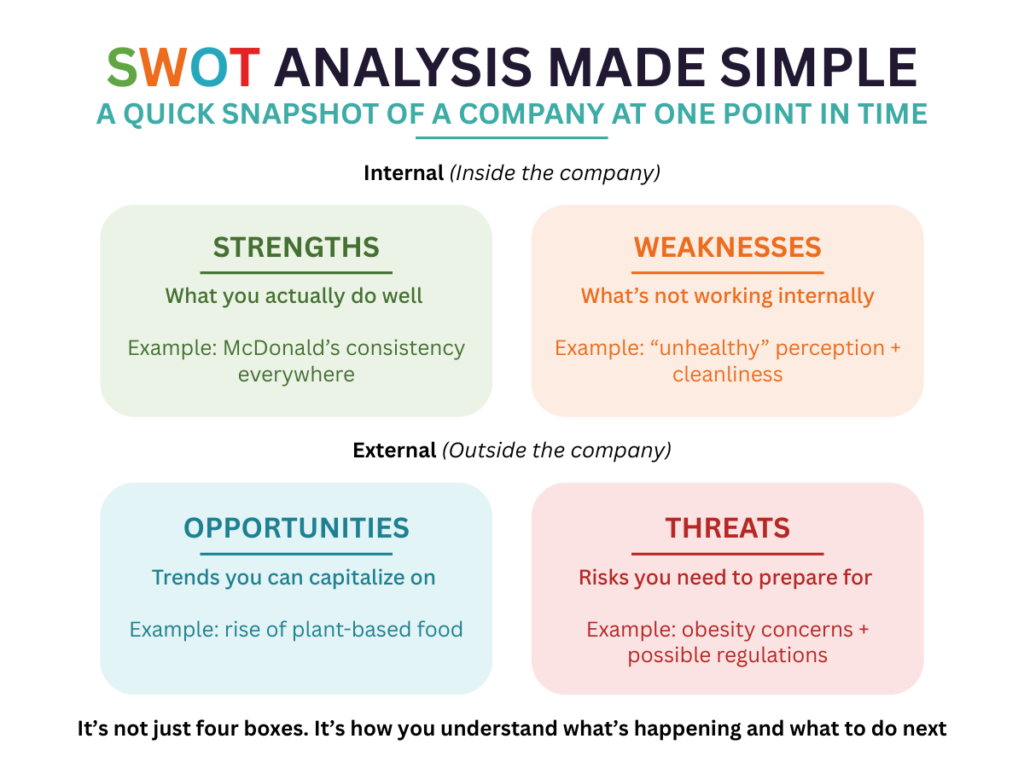
A SWOT analysis, at its core, is just a snapshot of a company at a given time. You’re trying to get a sense of where the company is by considering both what’s happening inside the company and what’s happening outside the company.
Inside the company, there are strengths and weaknesses. Those are things that the company can control. Outside the company, there are opportunities and there are threats. Those are things that happen outside the company that they can’t necessarily control, but that the organization needs to respond to.
Read More: Why Influencers Go Broke
As a result, this idea becomes a pretty important distinction because that’s how you think about strategy. You can change your weaknesses. You can leverage your strengths. But when you’re dealing with opportunities and threats, you have to be more reactive and flexible because those things happen outside the company.
Furthermore, when you think of a SWOT analysis in that way, you realize that it’s not just four boxes. It’s not just four lists. It’s a whole way of thinking about how a business works in the world.
Strengths: What You Actually Do Well
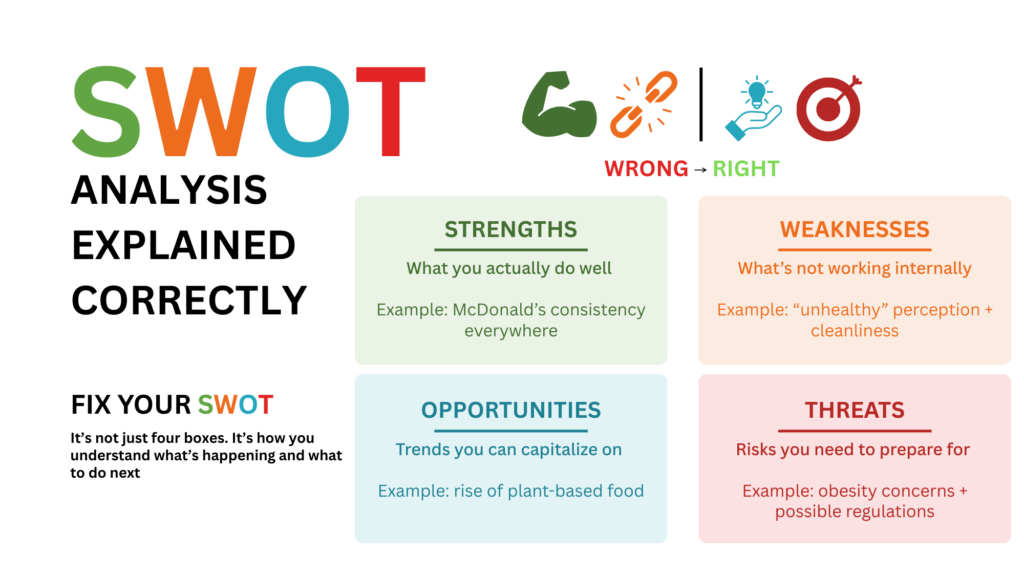
Strengths are the things that a company does well internally. These are the strengths or advantages a company uses to compete.
Professor Wolters used the example of McDonald’s, which made this really simple. One of the strengths of McDonald’s is consistency. If you get a Big Mac in Chicago, you know exactly what you’re getting when you get a Big Mac in another country. It’s the same food. That’s not an easy thing to accomplish, and that’s a big competitive advantage.
Another is the brand name. If you’re a kid, the Happy Meals are a big part of the brand name. That’s a strength because you create a connection with the people who are eating the food.
What was interesting was the fact that you don’t just list the strengths and move on. The real question is how you improve those strengths.
The example that was used was the fact that McDonald’s didn’t just stay with the same Happy Meal toy. Now they work with movie companies, and the toy is something a kid wants to keep. That’s an example of a strength and how you improve upon it.
Weaknesses: The Part People Avoid
I think weaknesses are probably the most uncomfortable part of a SWOT analysis, but they are probably one of the most important.
These are the internal parts of the company where the company is not doing well. It could be anything from how the customer views the company to the number of products the company is able to offer.
In the example of McDonald’s, a weakness could be the fact that their food is unhealthy. Another weakness could be the cleanliness of the restaurant. These are not external factors. These are internal factors that the company can change.
What Professor Wolters said, which I think is true, is the fact that people do not like talking about weaknesses. It is uncomfortable talking about what the company is doing wrong, especially in a group where no one wants to sound negative.
But if you do not identify your weaknesses honestly, you cannot improve.
It is not sufficient to just identify your weaknesses. You should think about what you are going to do about your weaknesses. For example, McDonald’s tries to overcome the weakness of being “unhealthy” by providing healthy food like apple slices, milk, or wraps. They also display these food items in their ads.
The basic idea behind this concept is that weaknesses should be directly linked to actions. It is of barely any use if your SWOT only identifies weaknesses but does nothing to solve them.
Opportunities: What’s Out There for You
Opportunities, in general, refer to external factors that the company can capitalize on. These factors often involve trends in the market, changes in the way consumers act, and innovations in technology.
One opportunity that was discussed in the video is the rise of plant-based foods. This is because more and more people seem to be interested in non-meat food, hence providing an opportunity for companies such as McDonald’s to diversify their food portfolio.
However, one thing that I realized is that it is quite easy to stop at just identifying the opportunities, where you could write something such as, “There is a growing demand for plant-based foods.”
However, that is not enough.
One has to consider the ways in which the company will capitalize on the opportunity. Will they develop a new product? Will they collaborate with another company? Will they conduct a pilot run in certain locations?
Opportunities only matter if you capitalize on them, not just ideas.
Read More: Best Practices for Influencers to Make Money Online
Threats: What Could Go Wrong
Threats are external factors which could harm the business. These are things you cannot control, but you can prepare for.
In the example of the McDonald’s restaurant, one of the biggest threats is the growing concern about childhood obesity. There is also the possibility of regulations being brought in, such as on children’s meals or on the number of calories in food.
These are things which could happen to the company, even though they are not directly the company’s fault.
The point of identifying threats is not to panic, but to prepare. You should try to think ahead and wonder what would happen if this occurred.
For example, if stricter health regulations are brought in, the company may need to alter its menu or its marketing. If the company is viewed in a negative light, the company may also need to alter how it is viewed.
Overall, a good SWOT analysis helps you think proactively instead of reacting too late.
The Biggest Mistake: Treating SWOT Like a Checklist
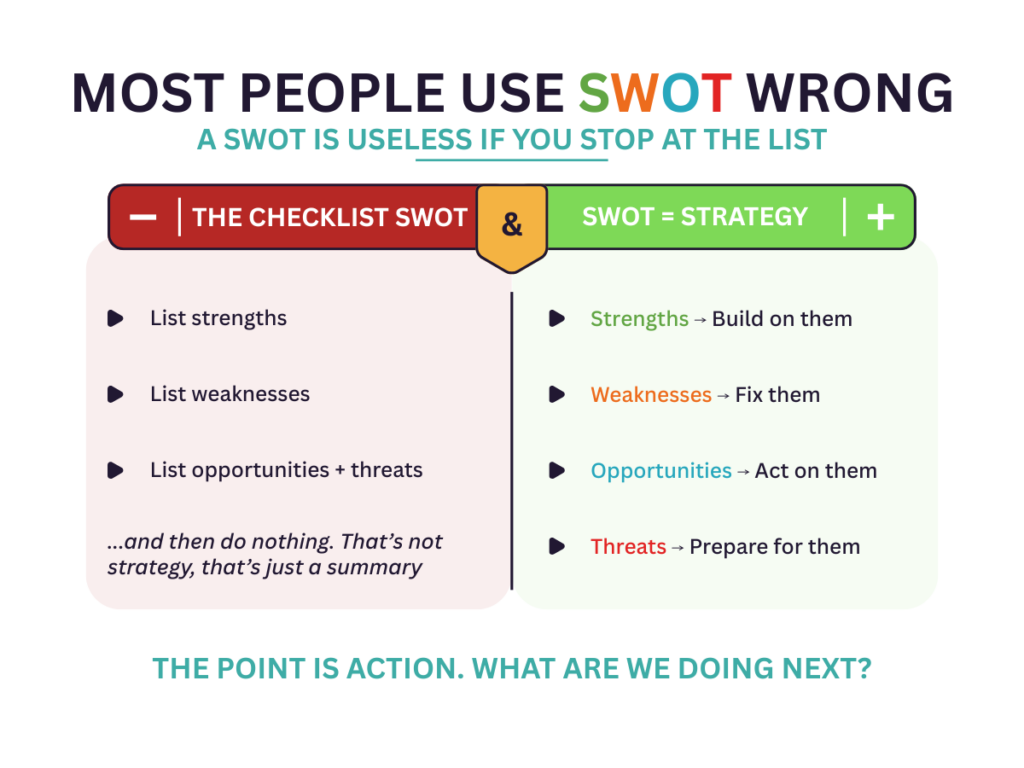
The biggest thing I took away from the video was that most people use SWOT analysis wrong.
They use it as a checklist rather than a tool.
They identify their strengths, weaknesses, opportunities, and threats, and don’t do anything with this information. It almost becomes a summary rather than a strategy.
Professor Wolters gives this example of complaining. We can complain about everything that is wrong. We can complain about everything that is going on. But if we don’t do anything about it, then nothing changes.
The right way to use a SWOT analysis forces you to ask yourself other questions. What are we going to do better? What are we going to do next? What are we going to do to be competitive?
Turning SWOT Into Strategy
If you want your SWOT analysis to actually be useful, you have to connect it to action.
Every section should lead to some kind of decision or plan.
When you’re thinking about your strengths, you should also be thinking about how to capitalize on those strengths. When you’re thinking about your weaknesses, you should also be thinking about how to eliminate those weaknesses. Opportunities should always be leading to action, and threats should always be leading to contingency planning.
It’s also a way to differentiate your work, especially if you’re doing this for a class.
Anyone can write down a list of ideas, but not everyone knows how to connect those ideas to a strategy.
Why SWOT Actually Matters for Students
At first glance, SWOT analysis might just be another assignment you have to do for school. But trust me, it’s something you will be using a lot, especially if you are going into marketing, consulting, or business strategy.
As an intern, you will be asked to analyze a certain brand or campaign. With case studies, SWOT will help you think more clearly about what you need to focus on. And in interviews, you will be asked to analyze a certain company. Truthfully, SWOT is just so easy to do.
You can even do SWOT analysis on yourself!
As a student, your strengths could be your communication skills, your knowledge of social media, and so forth. Your weaknesses could be your lack of experience, your time management skills, and so forth. Your opportunities could be internships, networking events, classes, and so forth. Your threats could be the job market, the economy, and so forth. It’s good to think this way because it will help you be more aware of your own growth, not just business growth.
Why Honesty Is So Important
Perhaps one of the most important aspects that I got from the video is the importance of being honest, especially when it comes to weaknesses.
It’s easy to point out our strengths and talk about our opportunities because it’s all positive. However, it is very important that we point out our weaknesses because that is where our true value lies.
If we don’t do that, then our analysis will be way off, and our strategy will be ineffective.
It’s especially crucial if we’re working in groups because we must be able to create an environment that allows people to be honest with us. Otherwise, we’ll be working with a SWOT that looks good on paper but is far from reality.
If it’s far from reality, then it’s useless.
How to Actually Do a SWOT Analysis the Right Way
If you’re doing a SWOT analysis as a class or a project, it should be a more involved process than just filling out the four boxes.
You should start with what’s happening inside your organization. This includes your strengths and weaknesses. Then you should look at what’s happening outside your organization and think about your opportunities and your threats.
However, the key to a SWOT analysis is to think about what your organization should do about what you’re talking about.
You should also think about what you consider to be most important, instead of just listing everything out. A shorter SWOT analysis is much more valuable to you than a long SWOT analysis with no direction.
Final Takeaway
One of the most used business tools is the SWOT analysis, but it is also one of the most misunderstood.
It is not just a matter of providing information; it is a matter of making decisions with the information.
One thing to take away from this discussion is:
The only way to make a SWOT analysis useful is to make it actionable.